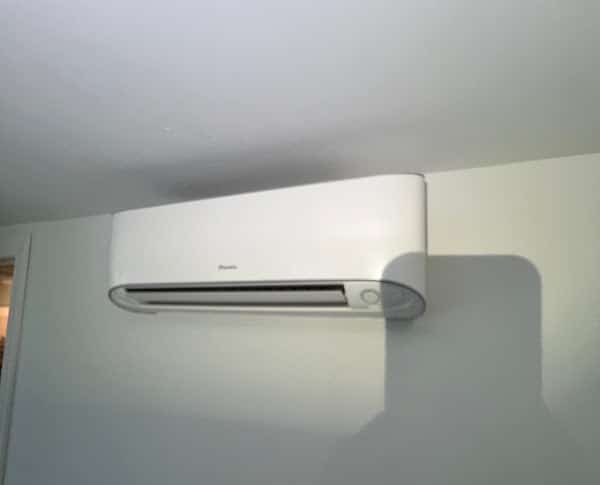
The register’s survey of Rectortown says its late-1800s houses follow two old plans, the hall-parlor and the I-house: rooms side by side, one deep, often two stories high. Those plans put each room against at least one exterior wall, so the refrigerant line from each head takes a short trip outdoors and none has to snake through the middle of the house. Two upstairs bedrooms on one outdoor unit are two zones, $11,000 to $15,000 installed.
The early-1900s houses are a different shape. The survey counts several bungalows in the village, a story and a half with big dormers, and an American Foursquare with a hip-roofed dormer of its own. The rooms up under those roofs bake in July: Warrenton 3 SE, the nearest long-record station, sees close to three weeks of 90 degree days a summer, and much of the village is roofed in standing-seam metal. A head in each dormer room covers that floor without touching whatever heats the first.
Then there are the buildings that started as something else. Several of the village’s general stores and its brick schoolhouse from about 1880 are dwellings now, the register notes. Big rooms, odd layouts and walls nobody wants opened make those natural ductless jobs, and so does an outbuilding made over into an office.
A mini split is a heat pump, so it warms a room as readily as it cools one, and that counts in a place with a long spring and fall. At the Warrenton station the median last freeze comes around April 9 and the first around November 1, and the weeks either side are when one head can carry a room without the main heat. January lows average near 25 and the County’s design temperature is 17, so a head heating a room alone gets picked for January.