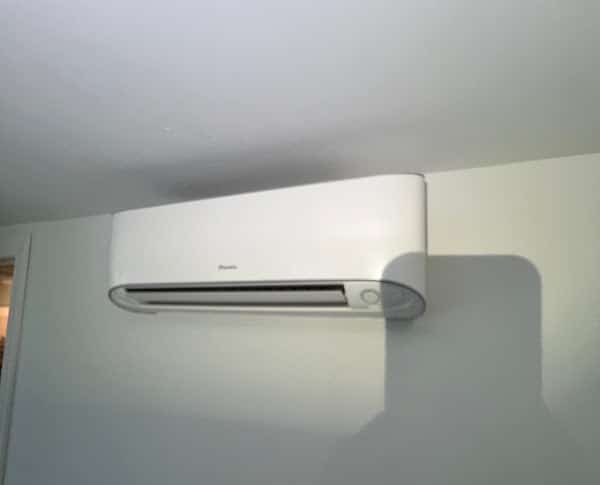
In a 2000s Ashburn house the basement was often left for the owner to finish, with a supply register or two cut into the main trunk and little or no return. That’s plenty for storage. Once it’s a gym, an office or a guest suite, it runs cold all winter while the thermostat two floors up says the house is fine. Close to six in ten Broadlands and Belmont homes are detached houses from the mid 2000s, and that basement, or the bonus room over the garage, is where a mini split usually goes.
Townhouses have their own version. Brambleton is close to half townhouses and Loudoun Valley Estates more than half, and the lowest level in many of them sits partly below grade, cool most of the year, now a home office or a teenager’s room. A head there gives it a setting of its own. Brambleton’s design review covers any added air conditioner or heat pump, and a mini split’s outdoor unit counts, so the application goes in before an install date gets set; expect the line set’s cover to run flush and be painted to match the siding.
Condos are the hardest case. University Center is mostly condo and small apartment buildings, with seven homes in ten rented, and in the Ashburn CDP itself more than a quarter of homes are in condo and apartment buildings. The outdoor unit needs a spot the association approves, so in a rented unit the owner applies, not the tenant.
The older-house reason for ductless barely exists here. Only about two Ashburn homes in a hundred predate 1980, so a whole house with no ducts at all is rare. The ductless work in Ashburn is rooms, one or two at a time, and that’s how it’s priced.