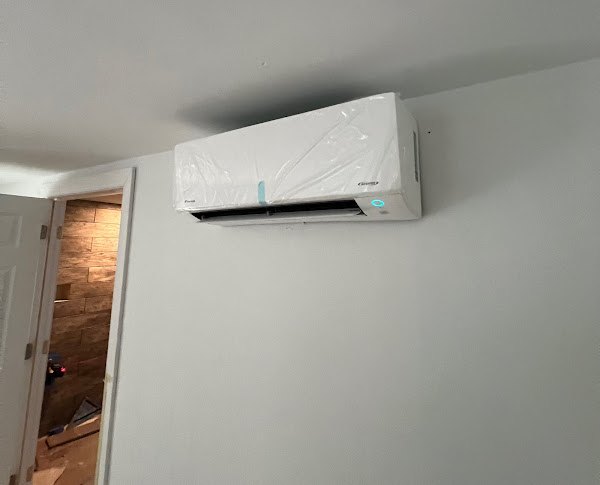
Thirty-one of Cook Inlet’s 108 townhouses are two and a half stories, by Fairfax County’s dwelling records, and all but one of those have dormers: a finished room tucked up under the roofline. It’s the last stop on the duct run and the first place the afternoon sun lands. The Weather Service logged a heat index of about 110 at Fort Belvoir on July 21, 2011, June 29, 2012 and August 13, 2016, and on days like that a dormer room on a builder system stays hot long after the rest of the house has cooled. One head up there gives it its own setting.
Below grade it runs the other way. The county records a finished rec room in 253 of Cook Inlet’s 256 basements, around 400 square feet at the median, and most of those basements are daylight basements with one wall partly above the yard. On the same thermostat as the bedrooms, a lower level like that usually runs cool in winter, and a head down there heats it on its own schedule.
Backlick Road in Accotink is older country. The county dates one house there to 1900 and six to 1925, and lists three Backlick Road houses with central heat but no central air. In a house that age, a mini split is the way to cool a few rooms without cutting new ductwork through old walls and ceilings: a small line set through an outside wall and a head high on the wall. Two rooms on one outdoor unit run $11,000 to $15,000 installed, three run $12,500 to $18,000.
Off post, Cook Inlet and Accotink are Fairfax County land, so a mini split goes through the county’s mechanical permit, with the county’s rules for the newer refrigerants below. On post it’s a different answer: The Villages at Belvoir owns those homes, and any change to their heating or cooling is the housing company’s call.