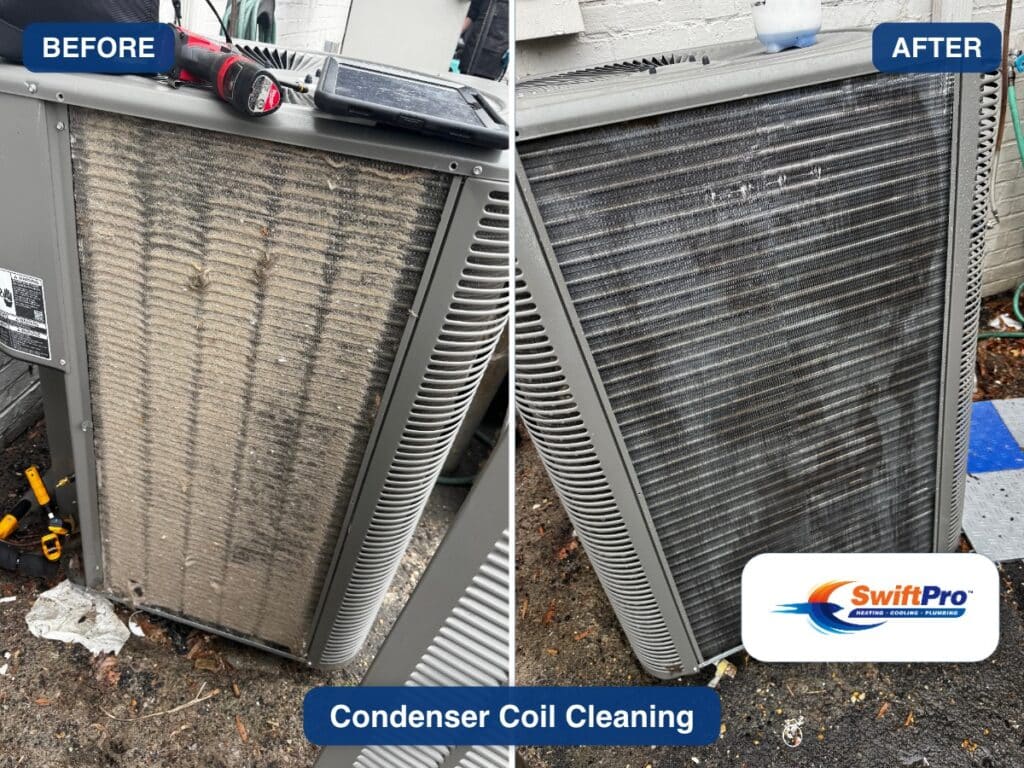
Fort Belvoir keeps no climate normals of its own. The nearest long record is Reagan National Airport, 13 miles up the river and, like the post, about ten feet above the tidal Potomac. Its 1991 to 2020 normals count 40 days a year at 90 or hotter, and the average July night only falls to 72, so a condenser here gets few cool nights to recover. The National Weather Service logged heat indexes around 110 at Fort Belvoir itself in 2011, 2012 and 2016.
Outside the fence, most of the houses we tune up are in Cook Inlet, off Inlet Cove, Point Replete and Stone Inlet Drives. Fairfax County’s records date nearly all 256 of them to 2002 through 2004, every one built with central air. So the condenser out back is either the original, past its twentieth summer, or a replacement, and the nameplate says which. An original from those years most likely holds R-22, none of which has been produced or imported since 2020, so a leak on one gets priced against old stock.
They’re two and two-and-a-half story houses over full basements, 148 detached and 108 townhouses. With gas heat the cooling coil usually rides on the furnace downstairs, and bigger detached houses of that era often add a second system for the top floor, an air handler in the attic. Each outdoor unit is its own $99.
Summer wind is the other hazard. A thunderstorm gust hit 66 mph at Davison Army Airfield on May 30, 2019, and that July a storm dropped a tree at Old Mill Road and Patton Boulevard. Afterward, look before switching the cooling back on: a limb across the fan grille, the unit shoved off its pad, insulation stripped off the copper. If anything looks wrong, leave it off and call us after the storm; we’ll check it all.