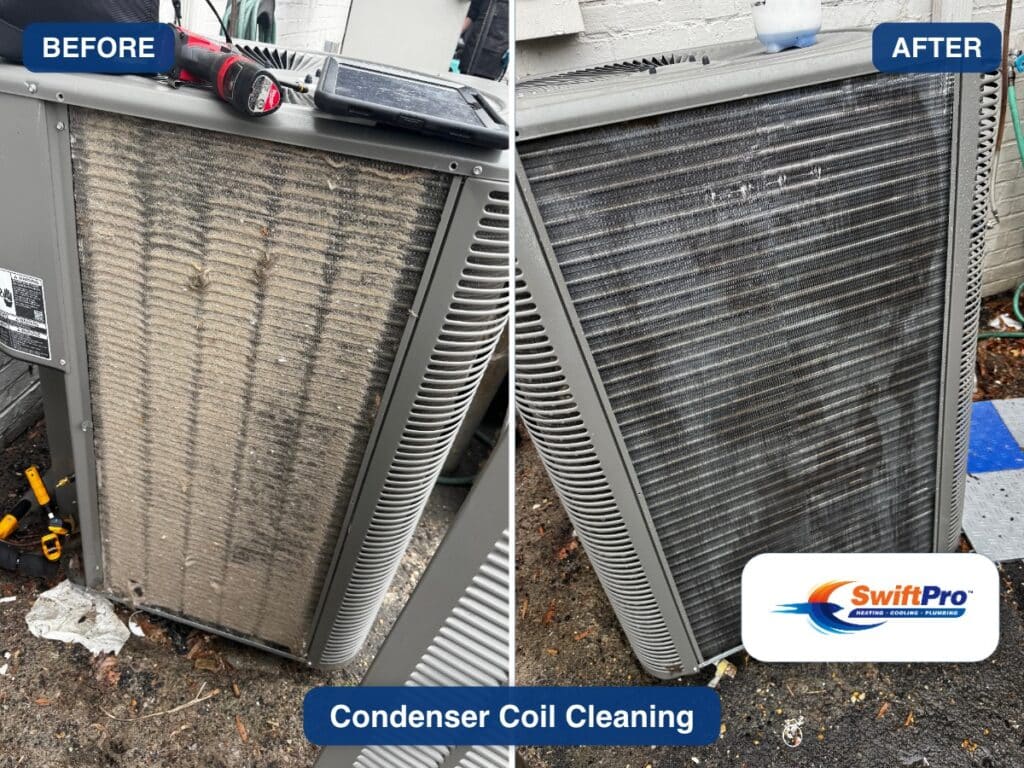
The nearest weather station with thirty years of normals is Warrenton 3 SE, roughly three miles west-northwest of the Casanova crossroads. From 1991 to 2020 it averaged a July high of 84.9 and 20.7 days a year that reach 90. The worst of it comes with the humidity. The Weather Service estimated heat indices over 115 across southern Fauquier on July 22, 2011, and over 110 on July 20 and 21, 2019. Afternoons like those are when a tired start capacitor gives out, or a condenser fan motor that’s been running hot finally stops, so the tune-up tests both while it’s still spring.
The village itself never planned on cooling. Its National Register nomination counts ten historic dwellings, put up between about 1880 and 1910, mostly frame houses on stone foundations under standing-seam metal roofs. Where an owner added air conditioning later, it’s usually an air handler tucked into the attic with short duct runs, or a ductless mini split with a head on the wall of each room. Either way there’s an indoor coil, a blower and a drain line, and a ductless mini split is the same $99 a system.
Out past the village, the houses are newer and the setups are simpler. The Census groups Casanova’s homes with Catlett’s ZIP, 20119, where the village’s map point falls, and there about half of owner homes heat with electricity. Out here that usually means a heat pump: one outdoor unit doing the cooling through the summer and the heating the rest of the year. Most of the others pair a propane furnace with a plain air conditioner, and the cooling half of that pair is what this visit covers.
Storms find the outdoor unit before they find anything else. On August 13, 2021, gusts estimated near 69 mph blew down numerous trees around where Casanova Road meets Meetze Road, about a mile west-northwest of the crossroads. On July 16, 2025, a flash flood sent at least a foot of water across Balls Mill Road near Moopack Lane. FEMA maps the crossroads itself as minimal flood hazard, but the ground along Turkey Run near the Meetze Road gauge is a mapped flood zone. After a storm, walk out to the unit before the cooling runs again: a limb on the grille, a dented cabinet, the pad knocked crooked, a muddy line up its side. If you see any of it, leave it off at the breaker and call us after the storm. We’ll check it all.