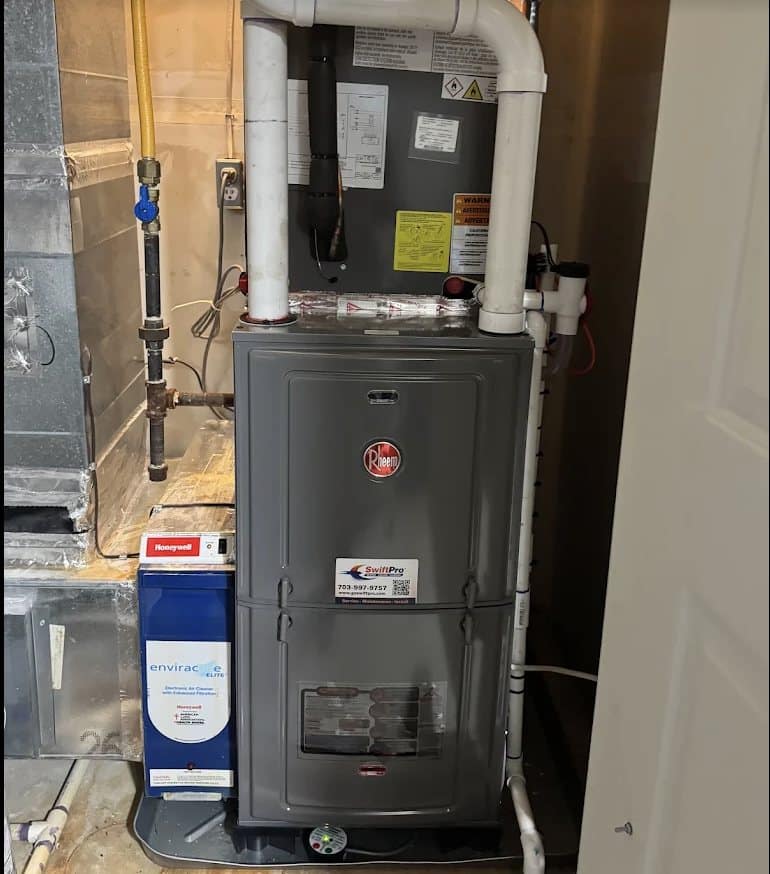
For the Census, Casanova sits inside ZIP 20119, and across that ZIP not one owner home heats with utility gas while close to 3 in 10 heat with propane. So a gas furnace here means propane, fed from a tank on the property, and the replacement starts at the tank as much as at the furnace. New furnaces leave the factory set up for natural gas; ours get converted for propane, and the line and regulator get checked against the new furnace’s input before the burners ever light.
Heating season runs long this low in the Piedmont. At Warrenton 3 SE, the NOAA normals station a few miles west-northwest of the village, the median last spring freeze comes around April 9 and the first fall freeze around November 1, and close to 13 days a year never climb above freezing at all. Then there are mornings like January 27, 2026, when the weather station at Warrenton-Fauquier Airport, about five miles south, read 3 below zero with a wind chill of 14 below. A tired inducer motor or a cracked heat exchanger tends to give out on exactly that kind of morning.
The village itself is older than nearly everything around it. Casanova’s historic district, listed on the National Register in 2005, is mostly frame houses from roughly 1880 to 1910, and Fauquier County’s village plan notes ground that runs shallow to bedrock in places, enough to rule out a basement on some lots. So the furnace in a Casanova house may live in a crawlspace, a closet or an attic, and the new one has to come in through whatever hatch or doorway the old one used. That opening gets measured before the furnace gets priced.
Wind is the other winter hazard. The nor’easter of March 2, 2018 brought a wave of calls to Fauquier County 911, most of them for trees and wires down. A propane furnace needs electricity for its igniter, its controls and its blower, so a long outage leaves the house cold with a full tank. If you run a generator, say so when we quote, so the new furnace’s wiring is ready for it.