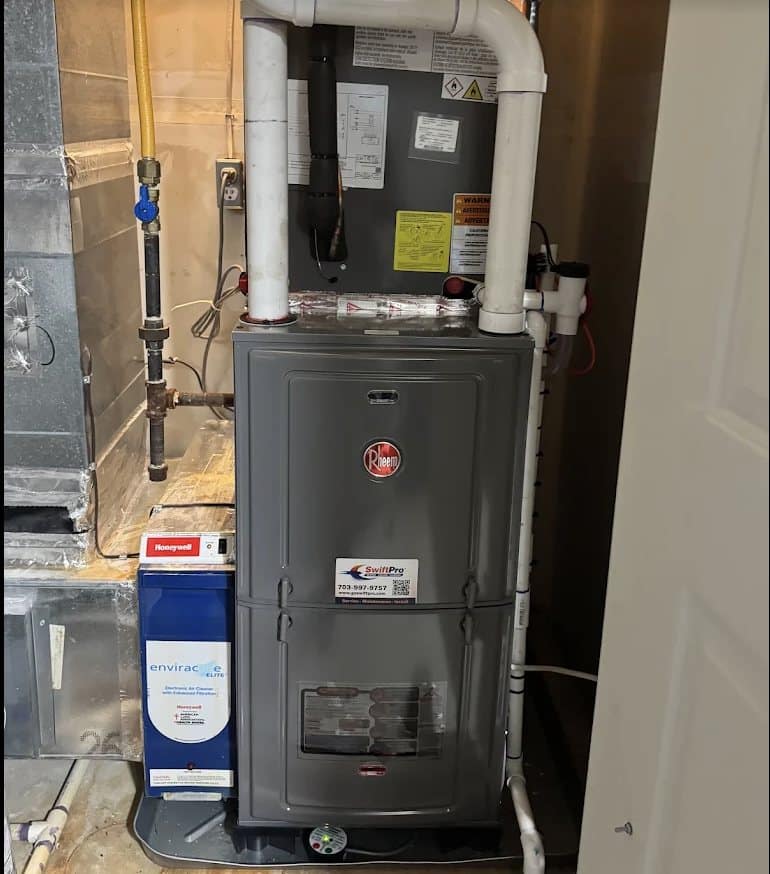
Gas is how Vienna keeps warm: about eight in ten owner homes inside the Town and three in four in Wolf Trap, from Washington Gas, the company Fairfax County names for most of its residents. Propane is rare here, about one owner home in a hundred, and we replace those furnaces too. Which part of Vienna the house sits in shapes most of the rest.
In the Town’s older houses, about two thirds built before 1980, the furnace usually sits in the basement beside the gas water heater, both on one masonry chimney. That chimney is where the 80 or 95 percent choice gets made. An 80 percent furnace can stay on it; a 95 percent one needs a wall to vent through and a drain for the water it makes. Fairfax County asks for a chimney vent certification with any fuel-burning appliance replacement, so the chimney gets looked at either way, and Washington Gas pays its Virginia furnace rebate only from 95.1 percent up.
About a quarter of the Town’s homes went up after 2000, many of them rebuilds. Those usually split the heat between a basement furnace for the main floors and an attic one for the bedrooms, and the two rarely fail the same winter, so replace the one that’s failing. The attic one goes up through the same hatch or pull-down stairs, and that opening shapes the price too.
Keeping the air conditioner takes three checks first: the refrigerant on the outdoor unit’s label (R-22 means it predates 2010 and is near its own end), whether the coil on the furnace matches the new cabinet’s width, and the blower setting for that air conditioner’s size. In Windover Heights, the historic district in northwest Vienna, a new vent pipe on a wall the street can see is an exterior change, so ask about the Board of Review before choosing a high-efficiency furnace.