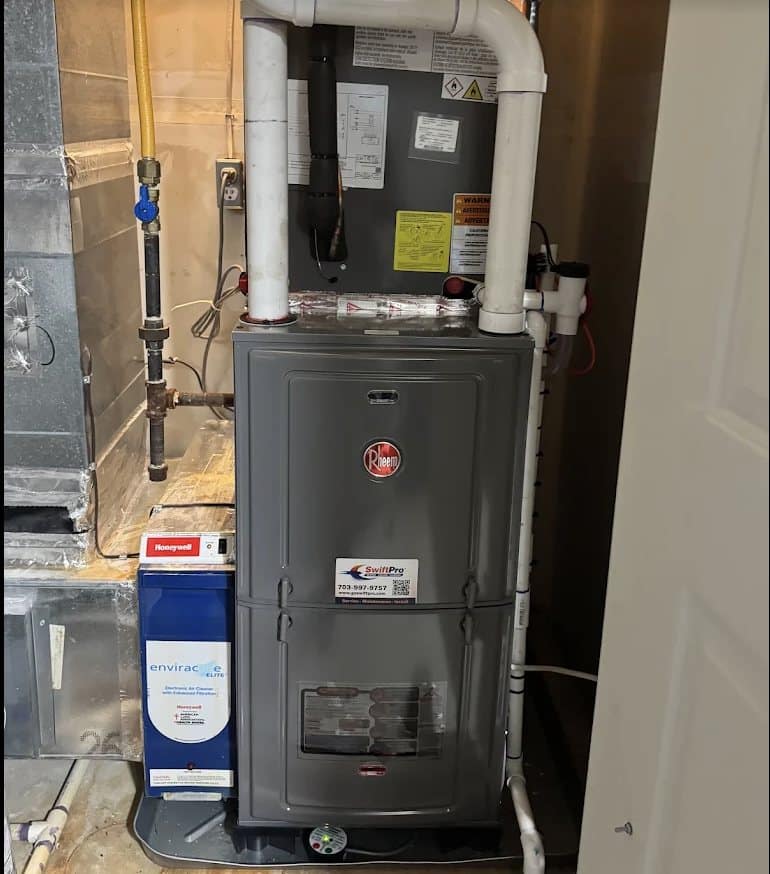
Piped natural gas is close to absent from 20158. The Census counts 22 owner homes heating with it, against 373 on propane and 665 on electricity, so a furnace we replace here almost always burns propane from a tank on the lot. Often it stands behind a heat pump that handles the milder weather, and this job keeps that outdoor unit and swaps only the furnace.
Winter here runs deep. The nearest NOAA station with long temperature records, the co-op in Purcellville 2.6 miles west-northwest, sits at about Hamilton’s 500 feet. Its 1991 to 2020 normals put close to 1,000 heating degree days in January alone, and more than half the year’s 4,942 fall from December through February, the months a heat pump hands more of the house to the flame behind it.
Some winters press harder. From January 25 through February 2, 2026, that station logged nine days in a row that never got above freezing, highs between 16 and 27 degrees; its daily records since 1960 show only two longer runs. On January 23, 2025, a weather station in Hamilton read 5 below zero, a reading the Weather Service lists as unofficial.
The Census dates 249 homes in the ZIP to before 1960, and the Town’s plan calls most of what stands in town late Victorian; there the furnace tends to sit in a basement, sharing a brick flue with the water heater. Another 657 went up in the 2000s and 2010s, so a propane furnace original to an early one has lit some twenty winters. A high-efficiency replacement usually exhausts through a side wall in plastic pipe, so the quote should show where.