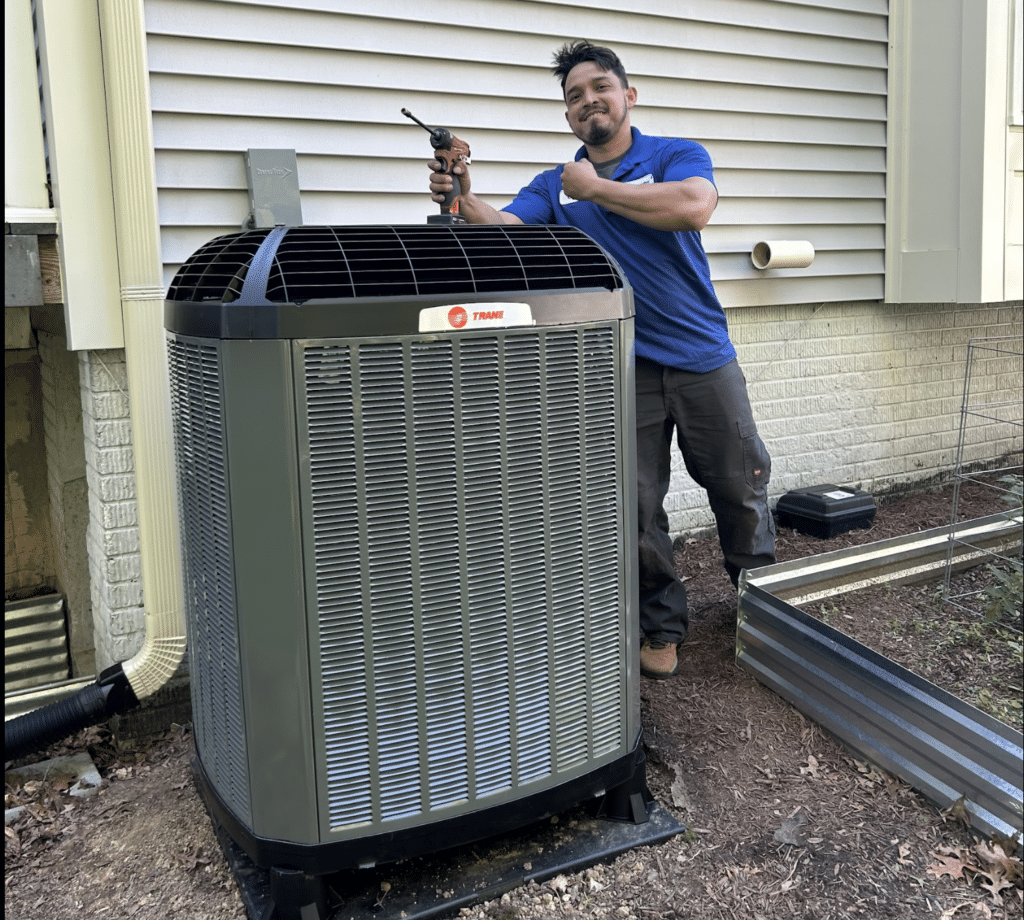
The Purcellville weather station, 2.6 miles west-northwest of Hamilton, averages 30 days a year at 90 degrees or more, and July’s average low there, 65.5, means the nights still cool off. That rewards an air conditioner sized to the house, not oversized: a big unit cools fast, shuts off before it pulls the damp out, and leaves the rooms clammy.
Hamilton’s storms come with trees. On July 25, 2010, thunderstorm winds estimated at 57 knots left at least thirty trees down across Hamilton, the fire department reported. On July 21, 2019, winds estimated at 61 knots damaged a roof in the 39000 block of Meadowlark Drive and put trees down between town and the Route 9 and Route 704 intersection, a road Tropical Storm Irene’s fallen trees closed in 2011. A limb through the top of a twenty-year-old outdoor unit usually ends the repair conversation.
Fuel decides the pair. In the 373 owner homes on propane, it’s a furnace burning propane with an air conditioner or heat pump outside, $8,898 to $23,000 installed for both. The 665 all-electric homes have an air handler with backup strips instead, and their matching swap is a heat pump system, $8,499 to $21,650. If the outdoor unit is newer than the furnace, it may be the furnace alone at $4,285 to $14,040.
The Census dates 386 homes in 20158 to the 2000s and 271 to the 2010s, so the first builder pairs have passed twenty years, and an outdoor unit set before 2010 most likely runs on R-22. The 303 from the 1970s often keep their first ductwork, so measure it before sizing a new pair.