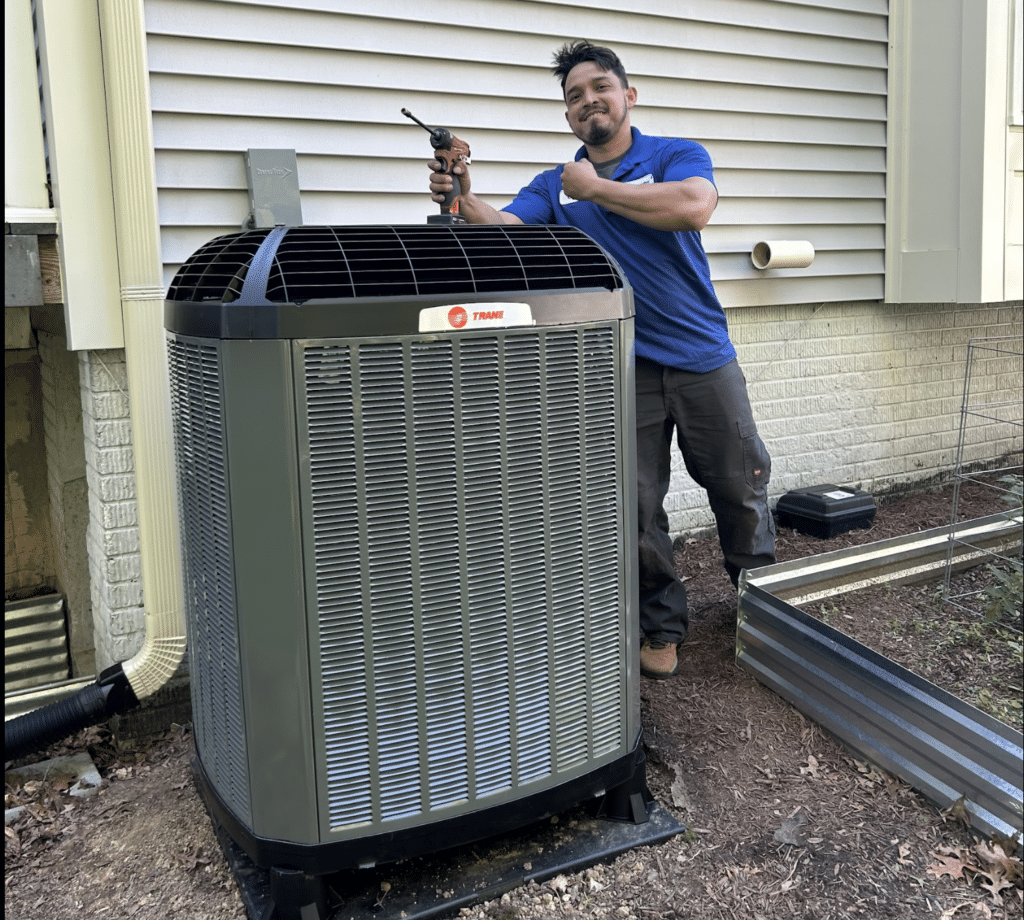
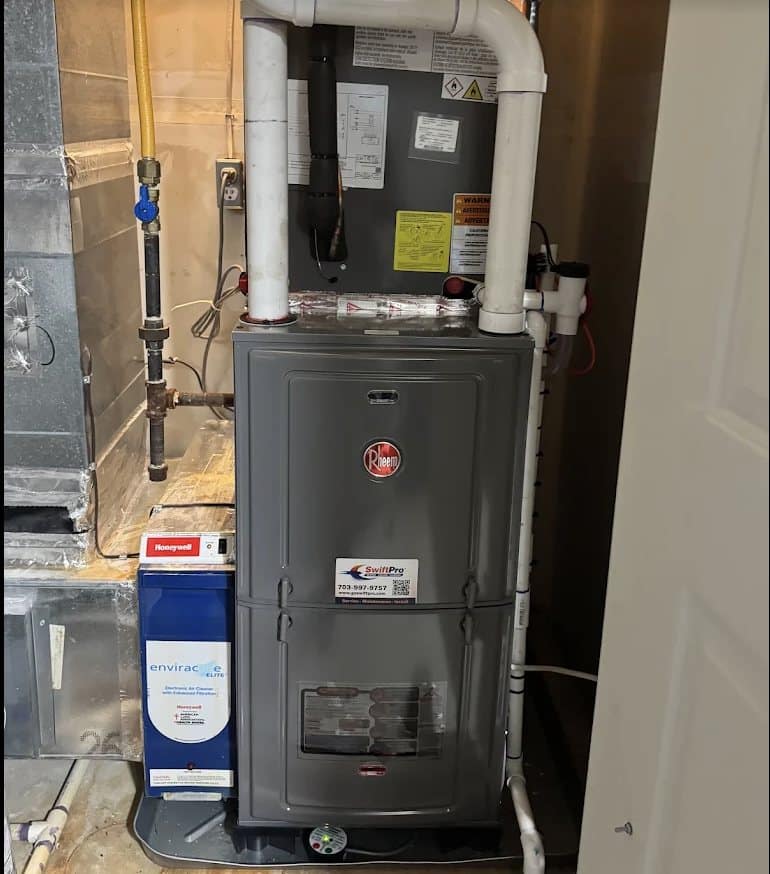
Fairfax County’s dwelling records list central air in all 256 Cook Inlet houses, its parcel records show gas connected to every one, and 251 of them went up between 2002 and 2004. So the typical off-post house with Fort Belvoir mail has a gas furnace in the basement and a condenser out back that started the same week. Unless one has been swapped already, they’re wearing out on the same calendar, and when the first one fails, the other is rarely far behind. (On post, heat and air belong to The Villages at Belvoir: put in a service request there.)
The outdoor half has had the harder life. Reagan National Airport, about 13 miles up the Potomac, averages 40 days a year at 90 degrees or hotter, and those are the afternoons an original condenser runs straight through. One built before 2010 most likely holds R-22, so on a builder unit a refrigerant leak is usually where the repairs stop. If the air conditioner was already replaced and only the furnace is original, the furnace alone runs $4,285 to $14,040.
Size is the part to get right. The county puts the typical detached house at about 3,080 square feet above ground, four bedrooms in most, plus a finished rec room downstairs. The townhouses run about 1,940 square feet, and 31 of them are two and a half stories, with a room up under the roof. Those systems were sized for a plan in 2003. We measure the house as it’s lived in now, and in the bigger houses that often turns up two systems, each priced as its own pair.
Storms add wear of their own. Hurricane Sandy brought gusts of 58 to 63 mph measured at Fort Belvoir in 2012, and a 66 mph gust crossed Davison Army Airfield in May 2019. After a blow like that, walk out to the condenser: a limb on the fins, a pad knocked out of level, or water that stood around the base all need a look before you run it hard. Cook Inlet sits on clay the county rates slow to drain. Call us after a storm and we’ll check it; if it won’t start, the diagnostic visit is $99.