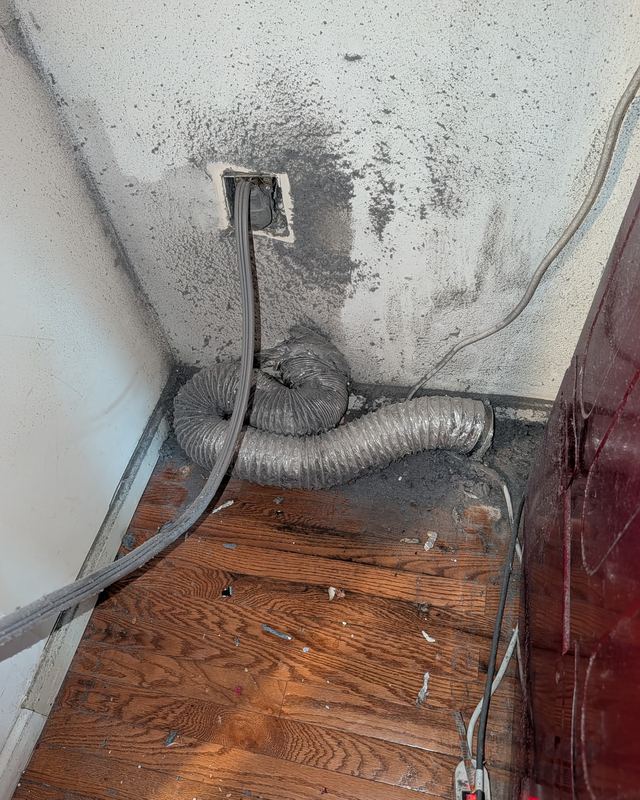
Fairfax County’s parcel records mark every one of Cook Inlet’s 256 lots as gas connected, so plenty of laundry rooms there run a gas dryer. A gas dryer sends its exhaust out the same dryer vent line as its lint and moisture, which makes a packed line on one more than a slow-drying nuisance. When we pull the machine out to reach the line, the flexible gas connector behind it gets a look before the dryer goes back against the wall.
Cook Inlet’s 108 townhouses add a layout problem. An inside unit has outside walls only at the front and the back, so wherever the builder put the laundry in 2003, the dryer vent line has to cross the house to reach one of them, threading between floor joists or turning up toward the roof. Each turn is a spot where lint settles and damp lint sticks. The 148 detached houses have side walls to work with, and their lines are usually shorter, with the hood on whatever wall sits nearest the dryer.
Then there’s the weather at the hood. NOAA’s storm records have a 66 mile an hour gust measured at Davison Army Airfield on post in May 2019, and gusts of 58 to 63 measured at Fort Belvoir during Sandy in October 2012. Wind like that cracks a plastic flap or jams it open, and an open flap invites birds and leaves in. In February 2021 the same records put about a quarter inch of ice near and east of I-95 after a night of sleet and freezing rain, plenty to glaze a flap shut. After a storm like those, start a load and go look at the hood.
Accotink’s houses on Backlick Road are older, mostly from 1925 and 1978 by the county’s dates, about half without a basement, and gas isn’t available to nearly any of those lots, so the dryer there is most likely electric. A main-floor laundry in a house like that usually has a short line straight through the nearest wall. We work off post only: family housing on post is maintained by The Villages at Belvoir, and residents put in a service request with The Villages.