Midland keeps its own wind record. The weather station at the Warrenton-Fauquier Airport, inside the County’s Midland service district, measured a 74 mph gust on August 13, 2021, in the storm that uprooted trees several feet thick near Midland Road and Airport Road, and 67 mph on July 25, 2022. In October 2011 an EF0 tornado ran along Rogues Road and Midland Road and peeled the metal roof off the back of a farmhouse.
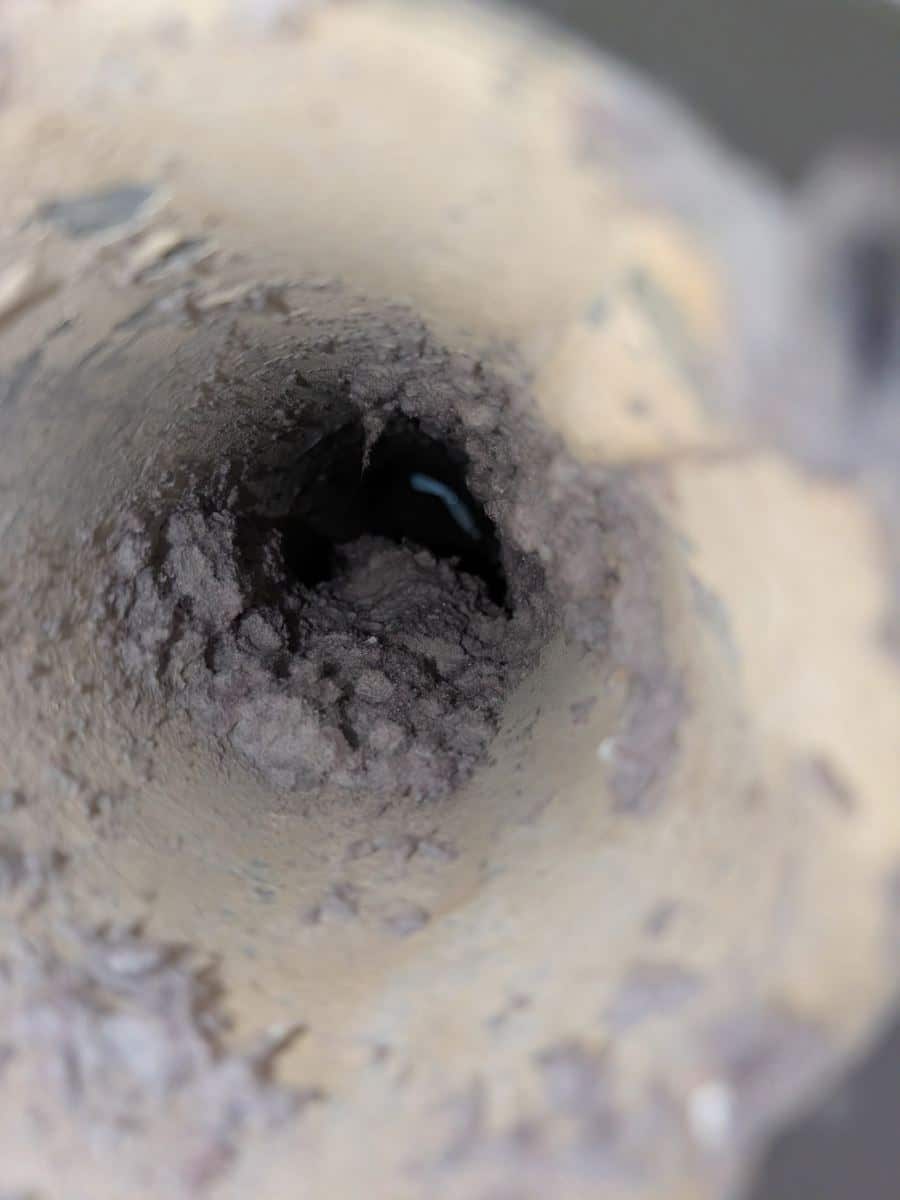
Wind like that cracks plastic dryer vent hoods, tears flaps off their hinges and stuffs leaves and twigs into whatever is left open. A hood stuck open invites nesting birds; one packed shut sends hot, wet air back up the line. Two weeks after that 2021 gust, more trees came down in Midland, one onto the wires on Rogues Road. After a storm like that, walk the outside walls, watch the hood while a load runs, and call us if the flap barely moves or the cover is broken.
The houses decide where the line goes. About 15 percent of the homes in ZIP 22728 went up in 1939 or earlier, many of them the wood-frame I-houses the County dates to 1880 through 1910. None was built with a laundry room. The washer and dryer landed later, in a back addition, an enclosed porch or a cellar corner, and the dryer vent line took whatever path the framing allowed, sometimes long, with turns, ending low on the siding.
Fuel sets what the line carries. Electricity heats 58 percent of owner homes here and propane 33 percent, with utility gas near 1 percent, so most Midland dryers are electric. A propane dryer, usually fed from the yard tank that runs the furnace, pushes burner exhaust out the same dryer vent line as the lint, so a crushed hose behind one matters twice over. Where the line crosses a crawl space over the Culpeper Basin’s shallow groundwater, the damp air cools in the run and wet lint sticks.