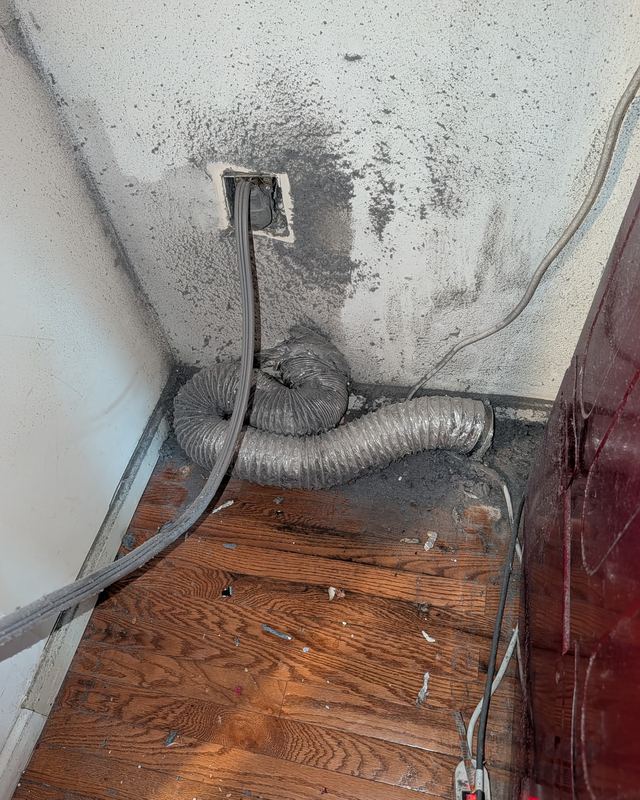
Plenty of Middleburg houses are older than the clothes dryer itself: about one home in four in 20117 dates from 1939 or earlier. In a house like that the laundry landed wherever there was room later, a cellar, an enclosed back porch, a mudroom, and the dryer line leaves by whatever path the walls allowed, sometimes through a stone or brick foundation with more elbows than a newer house would get. Every elbow is a place lint stops.
Inside the Historic District the outside end has rules of its own. The Town’s design guidelines put exhaust pipes and hoods the street can see under the Historic District Review Committee, in the least conspicuous spot, and a new one visible from a public way needs a Certificate of Appropriateness before the work starts. Cleaning the line and putting the same hood back is routine maintenance, which the Town excludes. Moving the line to another wall, or changing the hood’s shape, material or color, is not.
Summer storms are hard on that outside end. NOAA’s storm records note golf-ball hail just northwest of town and hail-broken windows to the east on June 16, 2016, and hundreds of trees, branches and wires down between Middleburg and Upperville in June 2022. A plastic louvered hood can crack under hail, and a falling limb can crush it or pull the line loose behind the wall. After a big storm, walk around and look before the next load.
Snow does its own damage. A trained spotter measured 34 inches in Middleburg after the January 2016 blizzard, and a low hood near the grade is buried under that much. About one owner in five here heats with propane, and where the dryer runs on propane too, its combustion gases leave through the same line as the lint, which makes a buried or blocked hood more than a slow dryer.