Family housing on post is The Villages at Belvoir’s to maintain, so a resident there puts in a service request with The Villages, not with us. This page is for the off-post 22060 houses: Cook Inlet, off Inlet Cove Drive and Point Replete Drive, and the older houses along Backlick Road in Accotink.
This is low country for Northern Virginia. The USGS puts the Fort Belvoir survey point about nine feet above sea level, on Coastal Plain beside the tidal Potomac. Reagan National Airport, about 13 miles upstream, keeps the nearest long-term record with the same river air: Julys average a high near 90 and a low near 72, with about 40 days a year at 90 or above. Those warm, damp nights keep a system running after dark, and much of its work is wringing water out of the air.
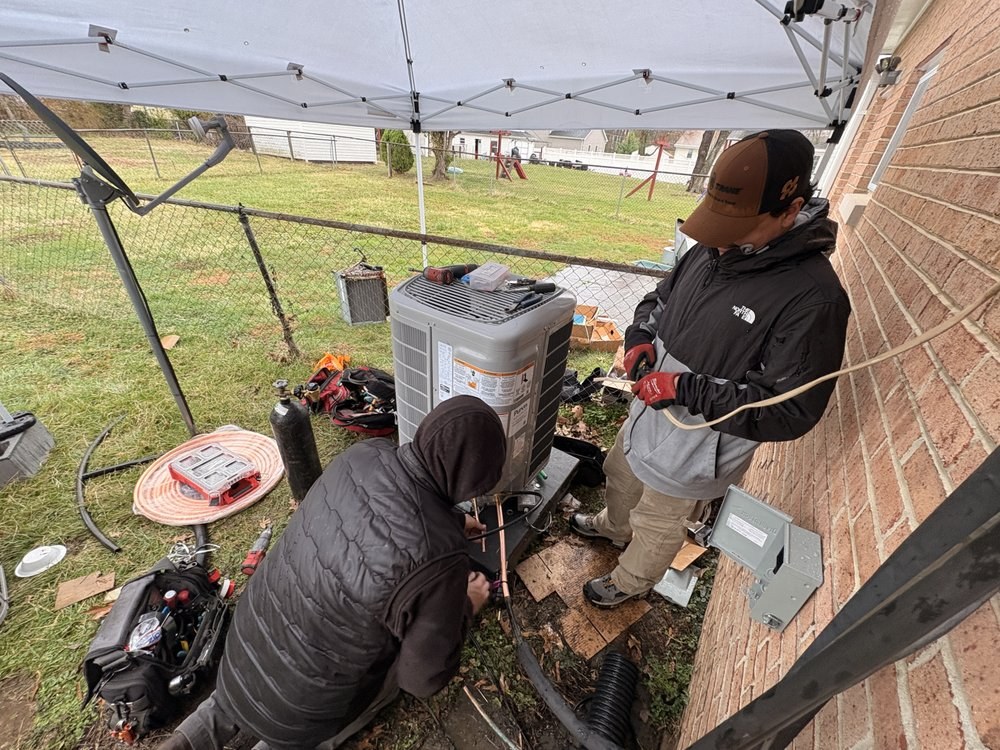
Fairfax County’s dwelling records list central air in every Cook Inlet house, nearly all built from 2002 to 2004, each with a full basement. So the cooling coil sits on the furnace downstairs, draining to a floor drain or a small condensate pump; when either clogs or quits, the first sign is a July puddle on the basement floor. Clearing the drain is $175 to $420. The original outdoor units have cooled through twenty-some summers, and a tired run capacitor, $240 to $370, is often all that stands between them and a hot night.
NOAA’s storm records logged heat indexes around 110 at Fort Belvoir in July 2011, June 2012 and August 2016, and a 66 mph gust across Davison Army Airfield on May 30, 2019. After a blow like that, look at the condenser before the cooling goes back on: branches against the coil, fins pressed flat, torn line insulation and, on this low ground, standing water around the pad. If anything looks off, leave it off and call us; we’ll check the unit, its wiring and its lines before it runs.