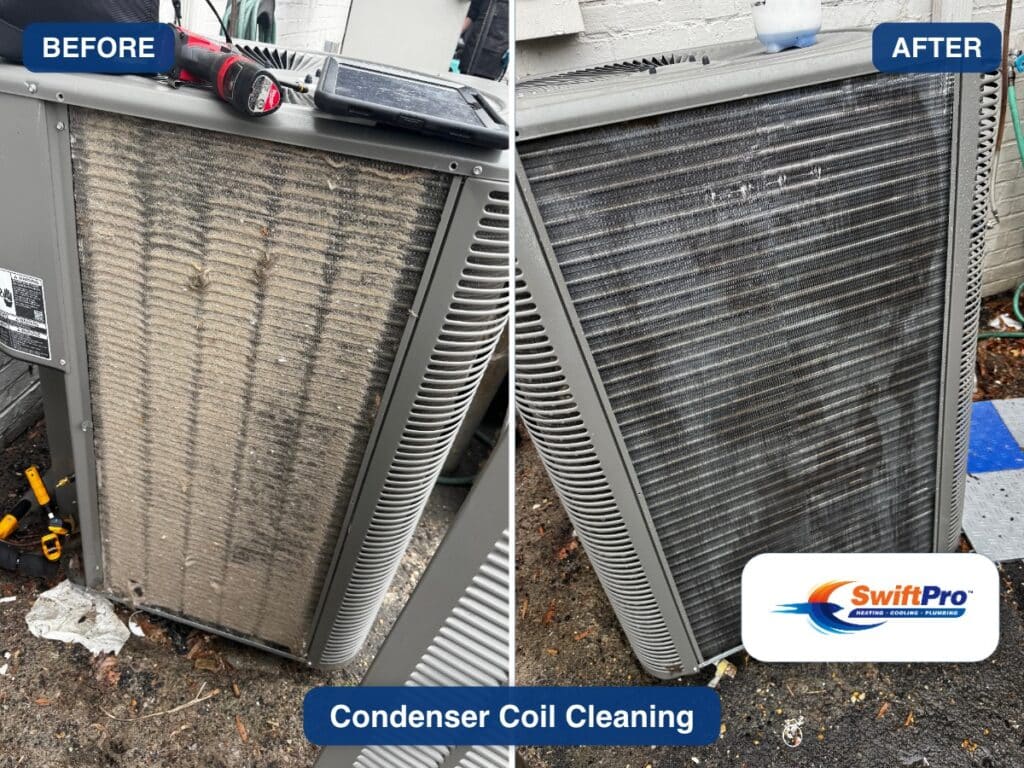
Grey lint caked on the outdoor coil
If the dryer exhausts near the condenser, lint mats the fins and the AC runs long without catching up. Kill the power at the disconnect, rinse the fins gently, and call if it still can’t keep the house cool.

Open 24/7 for emergencies

The diagnostic visit is $99, and a run capacitor replaced is $240 to $370 from our published price book.
Get your price in writing
Send this and the office calls or texts you back to set a time.
We’ll call or text this number about your request. By sending it you agree to our terms and privacy policy.
Rather talk now? (703) 997-9757
AC and heat pump repair in Centreville, 20120 and 20121, for the townhouse condensers and gas furnace systems most homes run. Priced from the book first.
5.0 stars across 1,132 reviews
One of our HVAC technicians beside an outdoor unit at a Northern Virginia home, the vans at the curb.
Licensed and insuredVirginia Class A contractor #2705192276
24/7 emergency serviceOften same-day, and we will tell you honestly when we can get there.
Our own HVAC installersA dedicated heating and cooling team, separate from our plumbers
Price in writing firstYou see every option priced before anything is ordered
What it costs
The same price book as our AC repair page. The diagnostic visit is $99, and the common parts ride on the truck, so most of these get fixed on the first visit.
Run capacitor replaced
$240 to $370
Contactor replaced
$290 to $425
Condensate drain cleared
$175 to $420
Refrigerant topped up
$190 to $740
Blower wheel pulled and cleaned
$300 to $440
Refrigerant leak found and repaired
$1,850 to $2,700
or $31/mo at 0% APR for 60 months
Repair diagnostic visit
$99
Monthly figures: 60mo @ 0% APR on each starting price, the whole price financed, on approved credit. Longer plans lower the payment and cost more in total. The lender sets the final terms. How financing works
Often same-day, and we will tell you honestly when we can get there.
With Comfort+ membership, $20 a month or $199 a year, the diagnostic visit is included, any service is 15% off, and the cooling and heating maintenance visits are part of the membership.
What’s different in Centreville
Centreville filled in during one long stretch. The median owner home went up in 1990, about seven in ten of all homes here were built between 1980 and 1999, and nearly half are townhouses. So the usual AC call is a condenser on a small pad behind a townhouse, sometimes tucked under the deck, wired to an indoor coil that sits on top of the furnace, and well past the unit the builder installed.
Close to three quarters of Centreville homeowners heat with gas, well above Chantilly next door, where the split is nearer half and half. Most systems here pair a cooling-only condenser with a gas furnace, so a July breakdown is nearly always on the cooling side by itself. The quarter of homes on electric heat usually have heat pumps instead, and a heat pump that limps through August tends to struggle again in January.
Two things about a townhouse backyard are hard on a condenser. When the dryer exhausts out the same back wall, lint drifts onto the fins and chokes the coil; with the power off at the disconnect, a gentle rinse from a garden hose clears most of it. And because the units stand side by side, yours and your neighbor’s can be very different ages, so the data plate on yours is the one that counts.
Two power companies serve Centreville. Fairfax County’s utility list puts most of the county on Dominion Energy and portions of Centreville and Clifton on NOVEC, the Northern Virginia Electric Cooperative. A repair is the same job either way. The rate you pay to run the AC, and any utility rebate on a new heat pump, come from whichever one sends the bill.
By the numbers
From the Census Bureau’s 2020 to 2024 survey. Median year built and heat count owner-occupied homes only.
What you’d notice
If the dryer exhausts near the condenser, lint mats the fins and the AC runs long without catching up. Kill the power at the disconnect, rinse the fins gently, and call if it still can’t keep the house cool.
Usually the outdoor unit has stopped running. A hum with no fan turning is almost always the run capacitor; silence while the thermostat calls is usually the contactor.
That’s an airflow problem far more often than a refrigerant problem: a clogged filter, a matted coil, or a blower wheel packed with dust.
Choosing who fixes it
Questions worth asking anybody who comes out, us included.
In a house from around 1990, today’s condenser is often the one that replaced the builder’s sometime in the 2000s, and a unit installed before 2010 most likely holds R-22, a refrigerant that stopped being made in 2020. A good tech checks before pricing a $1,850 to $2,700 leak repair, because on an R-22 system the replacement number belongs right next to it.
A company that prints what a capacitor or a contactor costs has already told you the number. One that won’t say until the tech is in your driveway hasn’t.
A healthy system drops the air somewhere around 16 to 22 degrees across the indoor coil. Low refrigerant means a leak, and topping it up every summer is the expensive way to find that out.
Some repairs aren’t worth doing on a 20-year-old system. The good answer shows you the repair price and the replacement price side by side and lets you pick.

Two of our crew going over a work order before the day's calls.
From our Google reviews
5.0 stars across 1,132 reviews. Read them on our reviews page.
Mr. Moises Rojas was great! A very experienced HVAC technician who carefully examined our very old AC system, and helped guide us through options for our original AC system. Highly recommended!

Questions
Yes. Each unit is wired to its own house through its own disconnect, usually a small box on the wall beside it. Tell us which one is yours when you book, and mention it if the units are packed close together or under a deck, so the tech knows how much room there is to work.
A repair doesn’t. A replacement is mechanical permit work, and for every Centreville address the office is Fairfax County. Since the move to A2L refrigerants, the county also wants that system’s certification filed alongside the permit application.
A three-level townhouse often cools all three floors from one system on the lowest level, so the bedrooms at the top get the longest supply runs and the sun beating on the roof right above them. Before anybody quotes a bigger unit, make sure the upstairs registers are open and nothing is blocking the return. A balancing damper, or a ductless head just for the top floor, usually settles it.
The diagnostic visit is $99. The common repairs: a run capacitor $240 to $370, a contactor $290 to $425, a condensate drain cleared $175 to $420, refrigerant topped up $190 to $740. A refrigerant leak repair runs $1,850 to $2,700.
Fix the cheap parts on almost anything. Think twice about a big repair on a system over 15 years old, and about any leak on an R-22 system. The HVAC estimator prices a new system in about a minute, so you can put the two numbers side by side.
Ready when you are
Call, or send the form at the top. The tech prices the repair from the book before starting, and if it’s the end of the road you’ll hear that first.
SwiftPro Heating, Cooling & Plumbing
4230 Lafayette Center Dr N, Chantilly, VA 20151
44679 Endicott Dr, Suite 211, Ashburn, VA 20147
Virginia Class A contractor license #2705192276
SwiftPro Heating, Cooling & Plumbing is a licensed, BBB Accredited (A rating), independently owned heating, cooling and plumbing company in Chantilly, serving Centreville and the rest of Northern Virginia. Virginia contractor license #2705192276. 5.0 stars across 1,132 reviews on Google, Angi, Yelp, the BBB and Facebook. SwiftPro maintains a dedicated HVAC team and a dedicated plumbing team.
From SwiftPro Heating, Cooling & Plumbing in Chantilly. Housing figures are the Census Bureau’s American Community Survey, 2020 to 2024, for each place named; permit, water and sewer facts link to each office’s own page and were checked in September and October 2026.