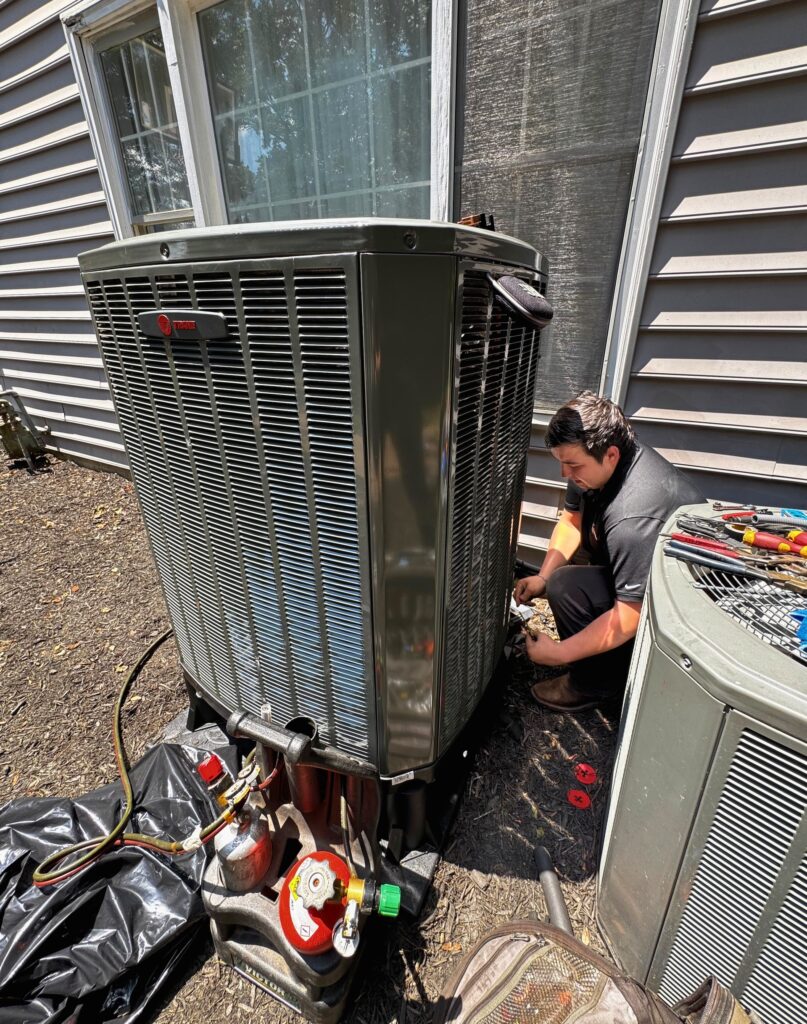
The village sits at about 449 feet on the valley floor, beside the USGS gauge on Goose Creek, between Lost Mountain and Little Cobbler Mountain. NOAA’s 1991 to 2020 normals from the nearest long-record station, outside Warrenton at about the same height, give an 85 degree July afternoon and roughly three weeks a year at 90 or hotter; July on the Blue Ridge crest at Mount Weather runs two and a half degrees cooler. The valley holds the heat, so a condenser here works hard from June into September.
The Census counts no natural gas heat in ZIP 20144. About half the owner homes burn propane, usually a propane furnace inside with its own air conditioner in the yard and the furnace’s blower moving the cold air. So weak cooling can start indoors, at a dusty blower wheel, a matted coil or a plugged drain, as easily as outside. Where the heat is electric, about three homes in ten, the outdoor unit is usually a heat pump carrying both seasons.
About four in ten homes here went up in the 1990s. A condenser from then would be past 25 now, so most are on their second, and one installed before 2010 likely runs R-22, which isn’t made anymore. When one of those leaks, set the repair beside a new system; our HVAC estimator prices it.
Summer storms are the other test. NOAA’s records describe gusts estimated at 80 to 90 mph across the Delaplane, Marshall and Ashville areas on June 22, 2022, laying big trees onto power lines along Cobbler Mountain Road, and golf-ball hail at Aspen Dale Winery, about two miles west-southwest, on June 2, 2019. After weather like that, check the unit before it runs a full afternoon: limbs on top, fins beaten flat, a tripped breaker. Then call us and we’ll go over the condenser, the wiring and the drain, priced before any repair.