Clifton splits by road. In the Census tract that takes in the town and the big lots on Clifton, Compton and Yates Ford Roads, about half the owner homes heat with electricity, which out here usually means a heat pump, the same outdoor box doing both jobs, July and January. Around Springstone Drive it flips. About 85 percent of owners in those 1980s subdivisions heat with natural gas, so the AC there is a cooling-only condenser feeding a coil that sits on a gas furnace.
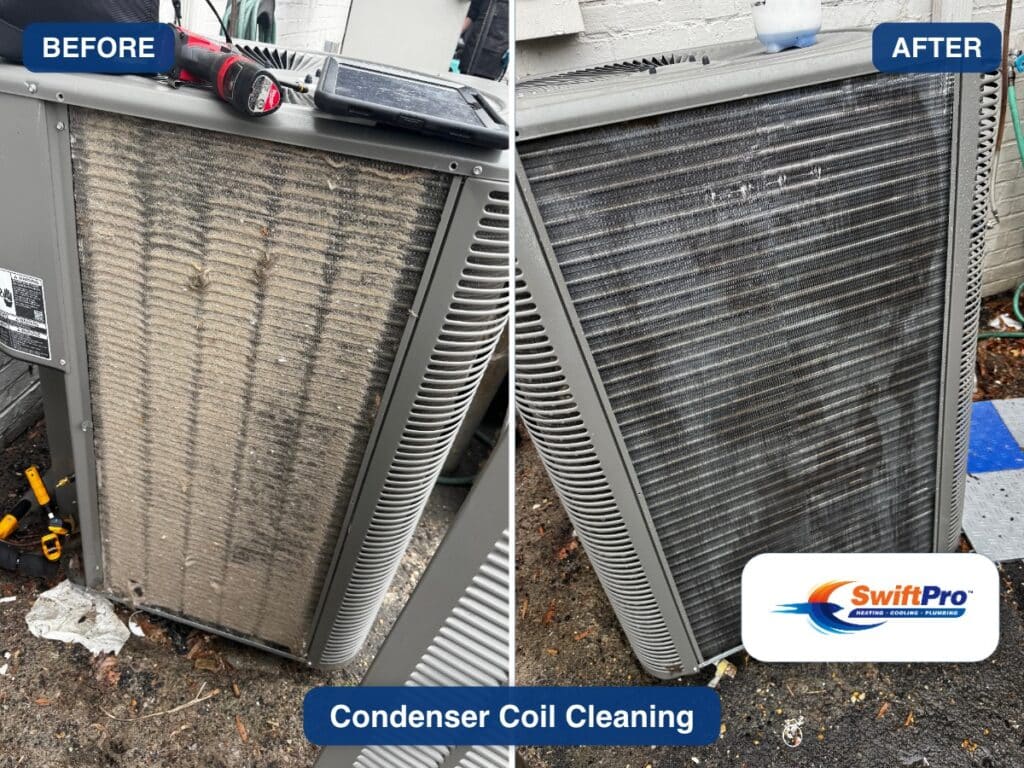
The houses run large. Six in ten homes in 20124 have nine rooms or more, more than twice the Fairfax County share, and a house that size often splits the load between two systems, one for the main floor and one for the bedrooms or the basement. If one level goes warm while the other holds, note which thermostat is losing before you call, and we start at the outdoor unit whose fan has stopped turning.
On a heat pump the July repair and the January one are the same machine. A refrigerant leak topped up in summer is still leaking at Christmas, when the electric backup strips, the expensive way to turn electricity into heat, pick up whatever the heat pump can’t. If the data plate on yours says R-22, the refrigerant inside hasn’t been made since 2020, and that changes the math on a $1,850 to $2,700 leak repair.
Inside the Town of Clifton most houses are frame buildings from the decades around 1900, older than air conditioning by half a century, so the cooling came later: ductwork worked into an attic or a crawlspace, or ductless heads on the walls. A repair inside needs nothing from the Town. An outdoor unit in a new spot, or a line set run up an outside wall, changes the exterior, and the Town’s FAQ sends any exterior change to its Architectural Review Board for a certificate before Fairfax County will take the permit.