It’s the original system
A house from the 2000s often still has its first air conditioner. Anything installed before 2010 usually runs R-22, which hasn’t been made since 2020, so a leak on one is a repair-or-replace question.

Open 24/7 for emergencies

The diagnostic visit is $99, and a run capacitor replaced is $240 to $370 from our published price book.
Get your price in writing
Send this and the office calls or texts you back to set a time.
We’ll call or text this number about your request. By sending it you agree to our terms and privacy policy.
Rather talk now? (703) 997-9757
AC and heat pump repair in Haymarket, from the Town’s 1990s houses to Dominion Valley and Piedmont, priced from our book before any work starts.
5.0 stars across 1,132 reviews
One of our HVAC technicians beside an outdoor unit at a Northern Virginia home, the vans at the curb.
Licensed and insuredVirginia Class A contractor #2705192276
24/7 emergency serviceOften same-day, and we will tell you honestly when we can get there.
Our own HVAC installersA dedicated heating and cooling team, separate from our plumbers
Price in writing firstYou see every option priced before anything is ordered
What it costs
The same price book as our AC repair page. The diagnostic visit is $99, and the common parts ride on the truck, so most of these get fixed on the first visit.
Run capacitor replaced
$240 to $370
Contactor replaced
$290 to $425
Condensate drain cleared
$175 to $420
Refrigerant topped up
$190 to $740
Blower wheel pulled and cleaned
$300 to $440
Refrigerant leak found and repaired
$1,850 to $2,700
or $31/mo at 0% APR for 60 months
Repair diagnostic visit
$99
Monthly figures: 60mo @ 0% APR on each starting price, the whole price financed, on approved credit. Longer plans lower the payment and cost more in total. The lender sets the final terms. How financing works
Often same-day, and we will tell you honestly when we can get there.
With Comfort+ membership, $20 a month or $199 a year, the diagnostic visit is included, any service is 15% off, and the cooling and heating maintenance visits are part of the membership.
What’s different in Haymarket
Inside the town limits the median owner home was built in 1995, and close to four in ten owners heat with electricity, which in a house that age is usually a heat pump. A heat pump does the cooling in August and the heating in February from one outdoor unit, so an AC problem in a town house often turns into a heating problem a few months on. Few of these houses still have the system they were built with, so check the manufacture date on the outdoor unit’s sticker before paying for a big part.
Across the rest of 20169 the houses are newer: the median owner home dates to 2006, and close to half of all homes went up in the 2000s. That puts plenty of original Dominion Valley and Piedmont condensers on the wrong side of a deadline. Equipment built before January 1, 2010 could still be charged with R-22, and no R-22 has been produced since 2020. If the sticker says R-22, a leak repair is money spent on a gas that only gets scarcer, and the replacement price belongs on the table next to it.
The Town adds a rule the county doesn’t have. The whole town has been a historic district since 1994, its design guidelines want outdoor heating and AC units screened from public view by a wall, a fence or planting, and its Architectural Review Board looks at changes the street can see before they happen. A capacitor, a contactor or a refrigerant repair changes nothing outside. A condenser moved to a new pad beside the front walk is a different conversation.
Up on Bull Run Mountain the cooling sits beside other kinds of heat. In Bull Run Mountain Estates, homes from 1978 at the median, oil heats about four in ten and electricity about as many. A central air conditioner paired with an oil furnace shares that furnace’s blower, so a weak summer airflow problem can start at a motor that also works all winter. The oil burner itself goes to an oil heat company; we don’t work on oil. Trading an AC or heat pump for the same kind in the same place takes no County permit anywhere in 20169.
Neighborhood by neighborhood
Census figures for each place, and what that usually means for the air conditioning. Median year built and heat count owner-occupied homes only.
| Place | Median home built | Most homes are | Heated with | What the cooling usually is |
|---|---|---|---|---|
| Bull Run Mountain Estates | 1978 | single-family houses, nearly all | electricity, about 4 in 10 | Little natural gas: heat pumps, or an AC beside a propane furnace. |
| Haymarket | 1995 | single-family houses, about 6 in 10 | gas, about 6 in 10 | 1980s and 90s houses, most on their second or third system. |
By the numbers
From the Census Bureau’s 2020 to 2024 survey. Median year built and heat count owner-occupied homes only.
Inside the town limits only, about one in eighteen of the owner homes with Haymarket mail. Dominion Valley, Piedmont and Bull Run Mountain Estates sit outside it, in the county.
ZIP 20169 as a whole: every Haymarket address, the Town’s homes included.
What you’d notice
A house from the 2000s often still has its first air conditioner. Anything installed before 2010 usually runs R-22, which hasn’t been made since 2020, so a leak on one is a repair-or-replace question.
Usually the outdoor unit has stopped running. A hum with no fan turning is almost always the run capacitor; silence while the thermostat calls is usually the contactor.
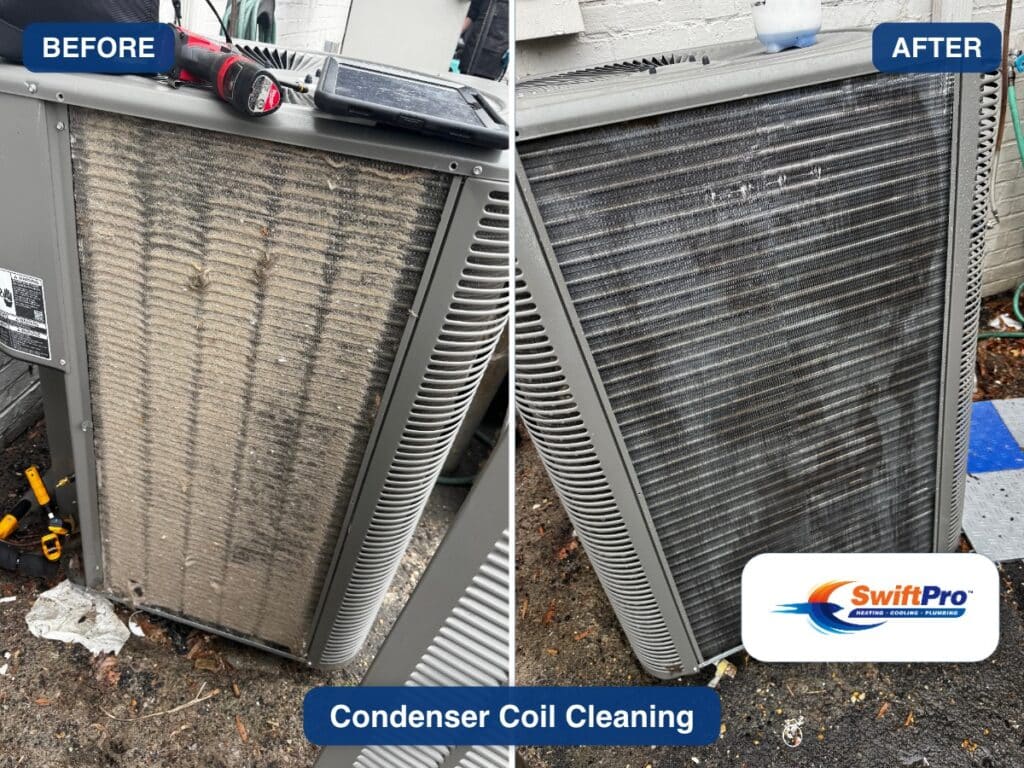
That’s an airflow problem far more often than a refrigerant problem: a clogged filter, a matted coil, or a blower wheel packed with dust.
Choosing who fixes it
Questions worth asking anybody who comes out, us included.
Inside the town limits, an outdoor AC unit the street can see is supposed to sit behind a wall, a fence or planting, and visible changes go through the Architectural Review Board. Hearing that at the quote costs nothing; hearing it from the Town after the install does.
A company that prints what a capacitor or a contactor costs has already told you the number. One that won’t say until the tech is in your driveway hasn’t.
A healthy system drops the air somewhere around 16 to 22 degrees across the indoor coil. Low refrigerant means a leak, and topping it up every summer is the expensive way to find that out.
Some repairs aren’t worth doing on a 20-year-old system. The good answer shows you the repair price and the replacement price side by side and lets you pick.

Two of our crew going over a work order before the day's calls.
From our Google reviews
5.0 stars across 1,132 reviews. Read them on our reviews page.
I called as a new client for a repair and they answered swiftly and fixed my AC. My technician Efrain did a great job explaining the problem and giving me solutions.

Where we work
Next door to Haymarket: Gainesville, Catharpin, Broad Run, The Plains and Aldie.
Questions
Not when it’s the same kind of unit going back where the old one stood: Prince William County lists that as no-permit work. A change of type or location needs one, and inside the Town of Haymarket the Town’s Zoning Approval comes before the County permit, with its Architectural Review Board looking at anything the street can see.
The sticker on the outdoor unit names the refrigerant. Units built before 2010 may say R-22; later ones say R-410A or something newer. On R-22 a leak repair runs $1,850 to $2,700 and a top-up $190 to $740, for a refrigerant that’s no longer made, so look at the replacement range first.
Turn it off and let it thaw. A coil that freezes in summer is short on refrigerant or short on air, from a clogged filter, a matted indoor coil or a blower that’s slowed down. Running it frozen puts the compressor at risk, and that’s the most expensive part of the system.
The diagnostic visit is $99. The common repairs: a run capacitor $240 to $370, a contactor $290 to $425, a condensate drain cleared $175 to $420, refrigerant topped up $190 to $740. A refrigerant leak repair runs $1,850 to $2,700.
Fix the cheap parts on almost anything. Think twice about a big repair on a system over 15 years old, and about any leak on an R-22 system. The HVAC estimator prices a new system in about a minute, so you can put the two numbers side by side.
Ready when you are
Call, or send the form at the top. The tech prices the repair from the book before starting, and if it’s the end of the road you’ll hear that first.
SwiftPro Heating, Cooling & Plumbing
4230 Lafayette Center Dr N, Chantilly, VA 20151
44679 Endicott Dr, Suite 211, Ashburn, VA 20147
Virginia Class A contractor license #2705192276
SwiftPro Heating, Cooling & Plumbing is a licensed, BBB Accredited (A rating), independently owned heating, cooling and plumbing company in Chantilly, serving Haymarket and the rest of Northern Virginia. Virginia contractor license #2705192276. 5.0 stars across 1,132 reviews on Google, Angi, Yelp, the BBB and Facebook. SwiftPro maintains a dedicated HVAC team and a dedicated plumbing team.
From SwiftPro Heating, Cooling & Plumbing in Chantilly. Housing figures are the Census Bureau’s American Community Survey, 2020 to 2024, for each place named; permit, water and sewer facts link to each office’s own page and were checked in September and October 2026.