Triangle’s closest long-term weather records come from the Marine Corps air station at Quantico, just under four miles south-southeast on the Potomac shore. Its July afternoons average 88 degrees, it counts about 1,500 cooling degree days a year, and on July 22, 2011, it measured a heat index of 118. On a sticky day like that, the system is pulling water out of the air along with the heat.
Gas heats about three Triangle owner homes in four, so the usual pairing is a gas furnace indoors wired to a cooling-only condenser in the yard. Roughly one in five heats with electricity, and those outdoor units are heat pumps that work every month of the year. Fix one in July and we switch it to heating before we leave, since a sticking reversing valve can hide until the first cold morning.
The houses come from two building booms. Carborough Heights was recorded with the County in 1946, Mockingbird Heights in 1950 and East Graham Park in 1959, years when few houses had central air, so their cooling was added later, with ducts threaded around rooms nobody planned them for. A back bedroom that won’t cool is often airflow before it’s refrigerant. Kerill Woods recorded in 2001, Lionsfield Valley and Moncure Woods in 2004, and there the builder’s condenser has now run about twenty summers.
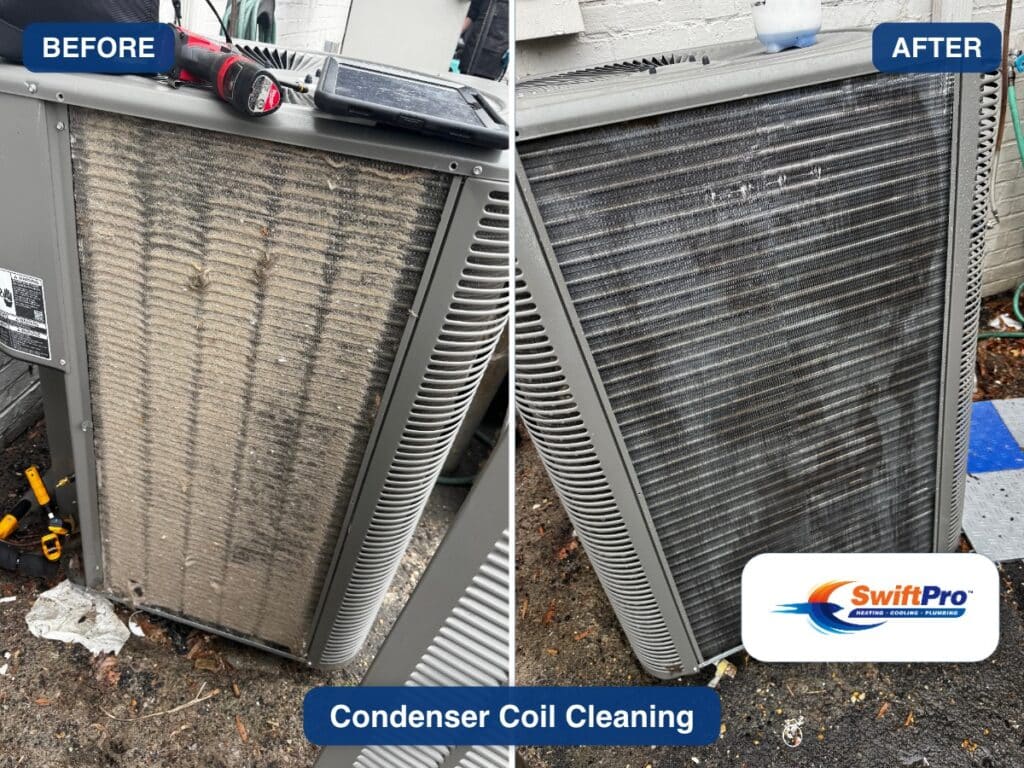
Storms do the rest. NOAA’s records log the October 2011 tornado that tracked from the Stafford line into Triangle and across I-95, a 66 mph gust at the air station in the June 2012 derecho, and trees down near Route 1, Cabin Road and Locust Shade Drive in August 2022. Afterward, look at the outdoor unit before the cooling goes back on: branches on the grille, fins pressed flat, torn foam on the copper lines. If floodwater reached it, as it swamped a car at Route 1 and Fuller Road in June 2018, keep that breaker switched off and phone us. We’ll go over the wiring before it runs.