Triangle’s weather numbers come from the Marine Corps air station at Quantico, 3.8 miles south-southeast, down on the Potomac shoreline. Its 1991 to 2020 normals put the average July high at 88 degrees and add up 1,512 cooling degree days a year, and on July 22, 2011 it measured a heat index of 118. A system here logs long afternoons all summer, so the spring visit is when a pitted contactor or a coil caked with last fall’s leaves should turn up, not during the first 90 degree week.
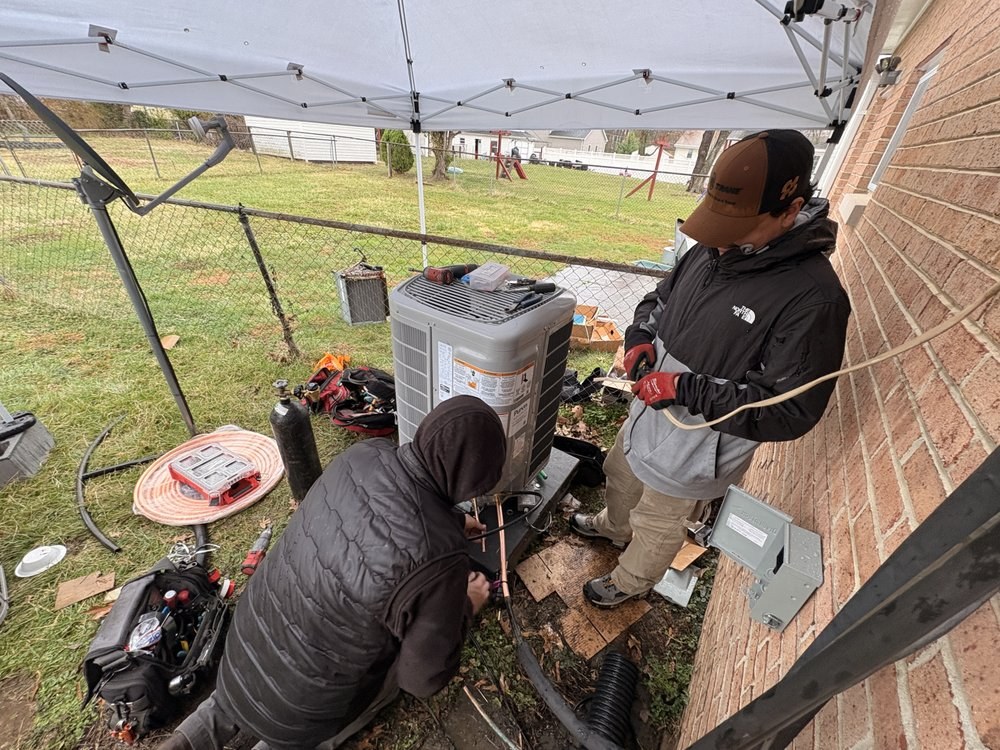
About half of Triangle’s homes went up after 2000. County plat records date Kerill Woods to 2001 and Lionsfield Valley and Cramers Ridge to 2004, so houses from that run got their condensers within a season of their neighbors, and plenty of those builder units are past twenty summers now. One that old most likely runs on R-22, which hasn’t been produced or imported in this country since 2020. If the write-up says it’s low, the useful talk is where the leak is and how many summers the unit has left.
Graham Park is the other Triangle. Its first plat was recorded in 1950, Carborough Heights is older still, and about one home in six here predates 1960. Nobody built central air into those houses. Where it came later, the ducts often snake through an attic or crawlspace never planned for them, and the return grille may be a size too small. A coil starved of air runs cold enough to ice, so in an older house the tech checks the airflow indoors first.
Summer storms here bring wind and water. The June 2012 derecho threw a 66 mph gust at the Quantico station, and an August 2022 thunderstorm knocked trees down in Triangle near Route 1, Cabin Road and Locust Shade Drive. Before switching the cooling back on after one, look at the condenser: limbs on the top grille, leaves pasted to the fins, the unit shoved off level, insulation torn off the copper lines. Near Little Creek, where a June 2018 flood submerged a car at Route 1 and Fuller Road, a unit that sat in water stays off until it’s checked. Call us after a storm and we’ll check it all.