The closest long weather record at Upperville’s height is the Purcellville co-op station, 14 miles northeast at 510 feet; the village sits near 557. NOAA’s 1991 to 2020 normals there put the average July afternoon at 86 degrees, with about 30 days a year reaching 90. Mount Weather, on the Blue Ridge five miles north, averages 82 and carries about a fifth less cooling load. Down on Route 50 a weak capacitor or a burned contactor picks the hottest week to quit.
The Census sample for ZIP 20184 is small, but it found no owner home heating with natural gas: roughly two in three use electricity, the rest propane. Electric heat out here nearly always means a heat pump, one outdoor unit cooling in July and heating in January, and its defrost control, $450 to $1,150 to replace, is easier to swap on a warm day than in a freeze. In a propane house, a dusty furnace blower wheel starves the coil; cleaning it is $300 to $440.
Most of the village predates air conditioning by a century: the 2021 National Register update for the Upperville Historic District dates 40 of its 136 main buildings to before 1861. When central air came to houses like those, the air handler often landed in the attic, its condensate pan right over old plaster. A clogged drain line up there shows first as a brown ring on the ceiling below. Clearing it is $175 to $420.
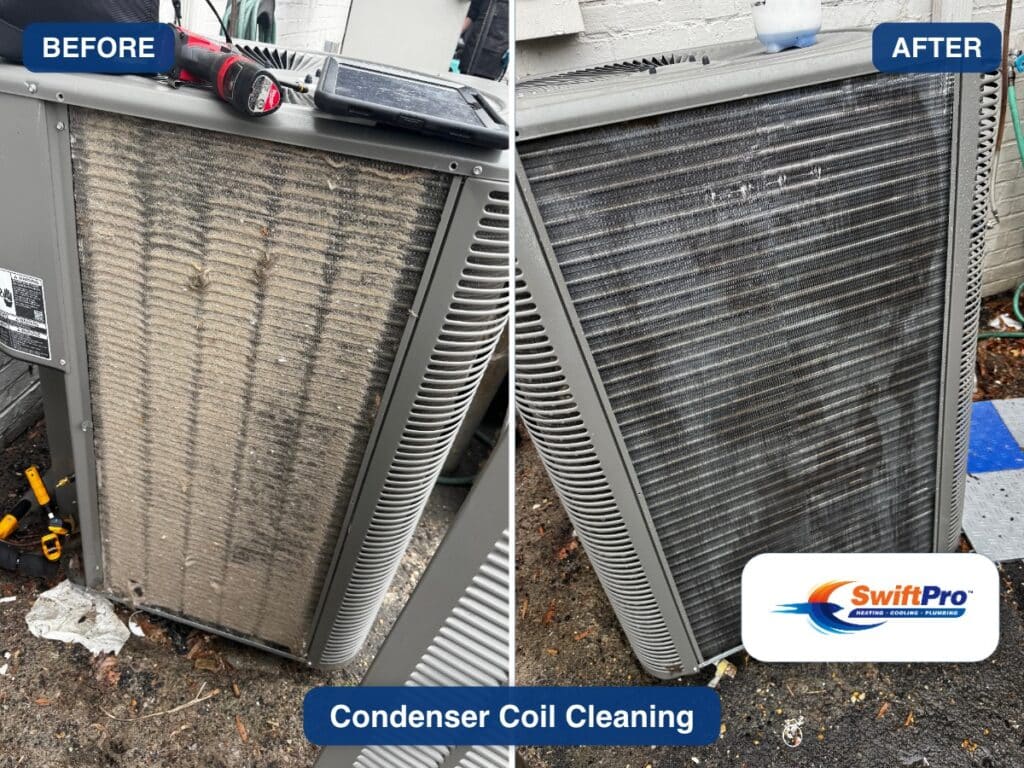
NOAA’s storm records note golf-ball hail near Upperville in August 2011 and again on August 10, 2021, when gusts near 70 mph also brought down trees and power lines off Route 50 by Trappe Road. On June 22, 2022, hundreds of trees and wires fell between Middleburg and Upperville. Afterward, check the outdoor unit before switching the cooling on: hail-flattened fins, a limb on the grille, leaves packed against the coil. Call us after a storm and we’ll check it all, outdoor coil to attic drain pan, priced first.