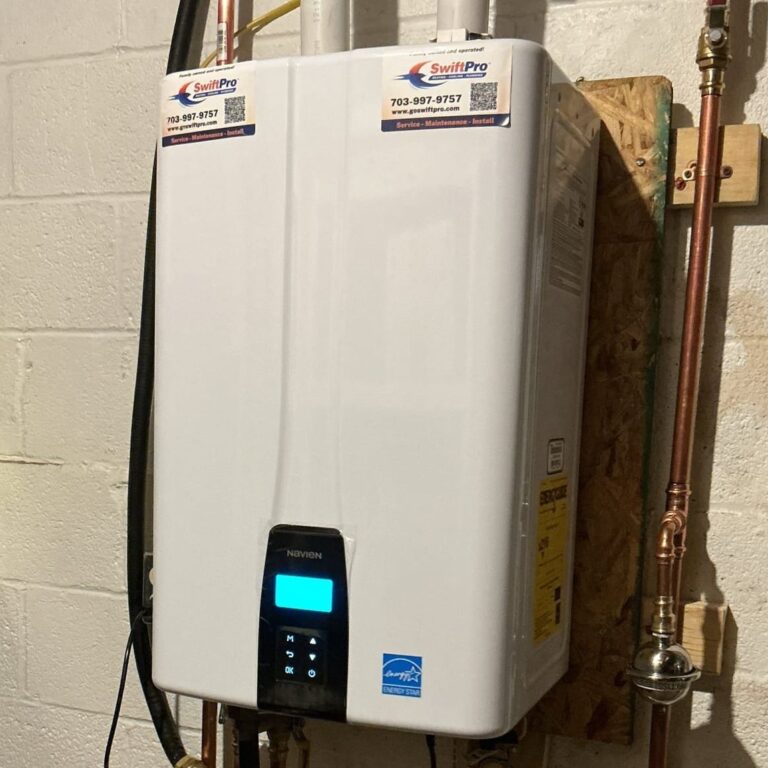
No water main reaches Upperville. Under Fauquier County’s plan, public utilities go only to designated service districts, and the village isn’t one, so each house draws from its own well. The geologic map puts layered granitic gneiss underneath, the hard crystalline rock of the Blue Ridge, where the USGS finds groundwater sitting lowest in the county. A well drilled into fractured rock can lift fine grit with the water, and the bottom of a water heater is where that grit stops moving.
Virginia Cooperative Extension tested 97 household samples across Fauquier County from 2012 to 2017, most from drilled wells 50 to 705 feet deep. Iron and manganese made its short list of the most common results over the standard, and both tend to drop out as rusty or black sediment. More than half the participants had treatment installed, a sediment filter most often. A filter catches what’s coarse; what gets past it lands in the tank.
Nearly half the samples tested below pH 6.5, water acidic enough to work on copper and brass once it’s in the house. Some households answer that with an acid neutralizer, a tank of crushed calcite the water runs through on its way in. It works by dissolving calcium into the water, which raises the hardness, and that calcium comes back out as scale wherever the water gets heated. If your well has a neutralizer and no softener, plan on a flush every year, and on a descale, $300, for a tankless.
Storms here bring the power down with the trees. In June 2022, gusts estimated at 70 knots put hundreds of trees and wires down between Middleburg and Upperville, and in May 2026 downed poles closed half a mile of Route 50 just west of the village. On a well, an outage stops the pump, and the first water after a long one can come up cloudy or spit air. Run a cold tap until it clears before drawing hot water, so the heater isn’t first to take in whatever comes up.