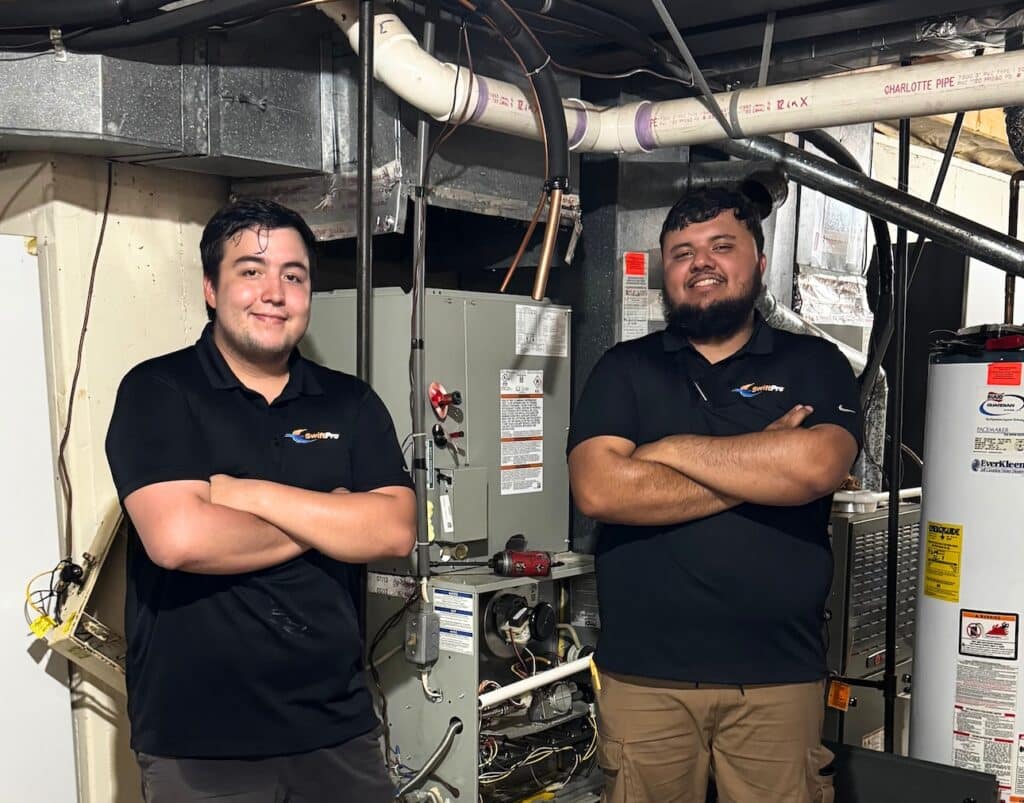
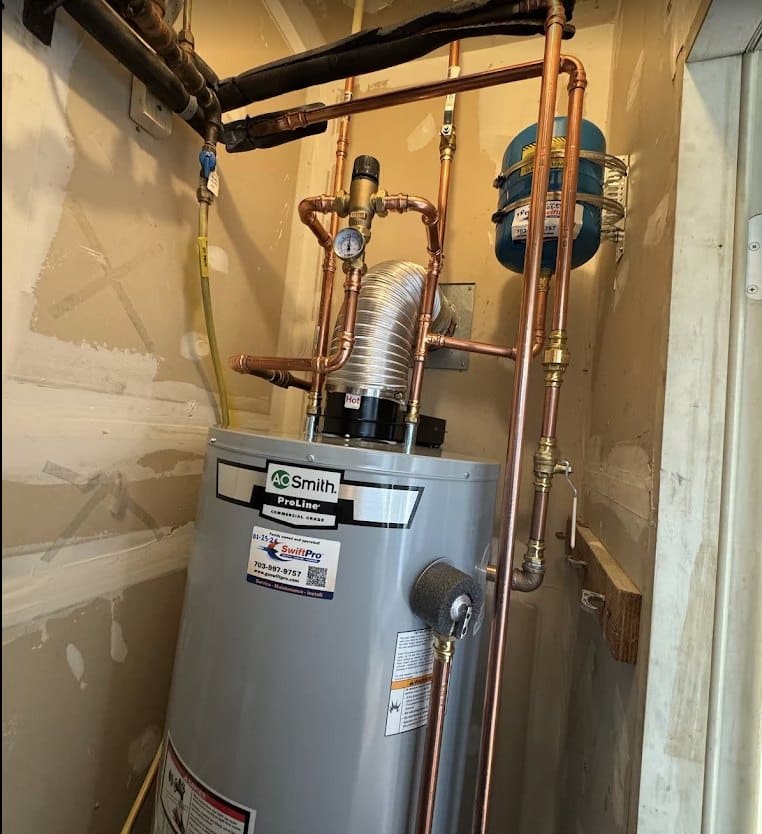
There’s no public water in Orlean. Fauquier County runs public water only inside its designated service districts, and the Fauquier County Water and Sanitation Authority’s 2025 report lists sixteen systems with none of them here. Every house draws from its own well, and the rock mapped under the village is the Marshall Metagranite, a granite. Nobody publishes a hardness number for a private well, which makes the tank itself the evidence: whatever runs out of the drain valve shows what your well has been sending in.
Virginia Cooperative Extension ran well clinics in Fauquier from 2012 to 2017 and tested 97 samples, mostly from drilled wells 50 to 705 feet deep. Close to half were acidic, under pH 6.5. Acidic water is hard on metal, so on an Orlean flush the anode rod, the rod that corrodes so the tank doesn’t, is the part we’d pull and look at. And if the house treats that water with a calcite neutralizer, the neutralizer works by dissolving mineral into the water, which leaves it harder on its way to the heater. More mineral going in means more scale settling on the bottom of the tank.
Timing matters out here. At Warrenton 3 SE, the long-term station nearest the village, the median first fall freeze comes around November 1, and close to five nights a year drop to 10 degrees or colder. A flush drains through a hose, and a hose across a frozen lawn is asking for trouble. October, before the cold settles in, is the easy month for it.
Outages can send grit, too. When a storm knocks out the power, the well pump stops, and the first rush when it starts again can stir up sediment that ends up in the water heater. If the hot side runs cloudy or sandy after an outage while the cold side has cleared, the sediment is in the tank, and draining it is the fix. The well itself is a well contractor’s job.