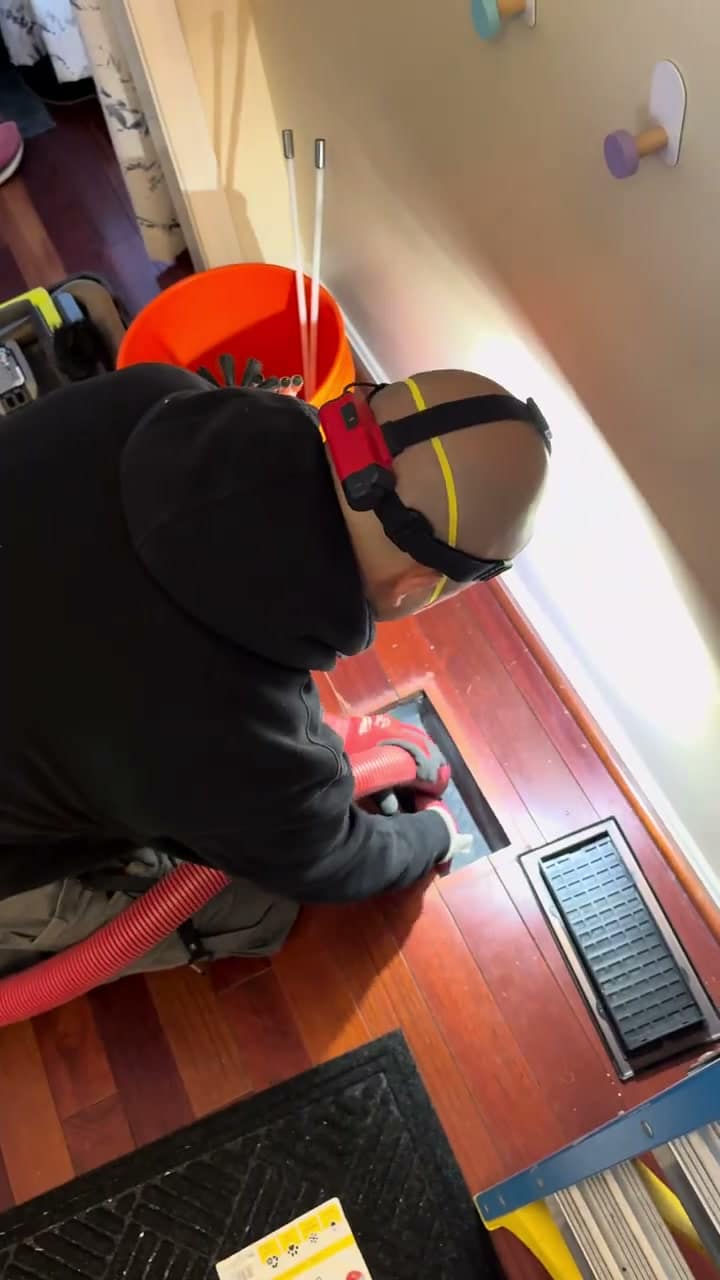
The co-op weather station called Warrenton 3 SE, our nearest source of long-term normals, logs about 4,685 heating degree days in a typical year and about 1,018 cooling degree days. Put plainly, heating outweighs cooling here more than four to one. Around the village a little over half the occupied homes heat with electricity, usually a heat pump moving air through the same ducts from fall into April. The returns, the big grilles that pull room air back to the system, do their dirtiest work in the cold months, so that’s where our camera goes in first.
Most Orlean houses are younger than the crossroads. In the Census block group centered on the village every home is a detached house, and about two in three were built from 1970 through 1999, usually with sheet-metal trunks below the first floor and flexible branches to the rooms. Fauquier County’s village plan warns that steep ground along Thumb Run and Cabin Branch can sit shallow on bedrock, which makes a basement hard to dig, so some houses there carry their ducts in a crawlspace, where a loose return joint draws in dust every time the blower starts.
In the old village the ductwork arrived last. The National Register nomination for the Orlean Historic District describes houses that grew in pieces on stone foundations: a log room from about 1795, a stone addition in 1812, a frame section built to join them. Central heating and cooling came much later, and the runs went wherever they’d fit: up a closet, across an attic floor, under a later wing. The photos show which stretches we can clean and which can’t be reached without opening a wall.
On June 22, 2022, the National Weather Service estimated gusts of 80 to 90 mph along a path that reached Orlean, with thousands of trees down and homes left with shingle and siding damage. If a storm or its roof repair opened your attic, an attic duct run can take in wet insulation and debris through a crushed section, and the camera finds it.