McLean is on Fairfax Water, but most of it isn’t served by Fairfax Water’s own plants: the utility’s 2026 report maps most of McLean in its Washington Aqueduct area, Potomac water treated by the Army Corps of Engineers. The river changes through the year and the tap follows it: Aqueduct water tested 5.6 to 10.9 grains of hardness per gallon in 2025, lowest in late spring and highest in December. That’s plenty for calcium to drop out as sediment on the floor of a tank, or crust the heat exchanger of a tankless, so a McLean flush is planned around the December number, once a year.
In the 1950s and 60s houses, close to four in ten homes in 22101, the gas water heater usually stands beside the furnace in the basement, often sharing its flue, and it’s several heaters removed from the one the builder put in. The newer big houses often run differently: two water heaters, or a single 75 or 80 gallon tank, sometimes with a recirculating pump for the far bathrooms. Two tanks means two flushes, so mention both when you book.
McLean is where we see boilers most. Hot-water heat is a regular part of our McLean heating work, far more than anywhere else we go. In many boiler houses the hot water comes from an indirect tank, a storage tank the boiler heats through a coil inside it. It has no burner or element of its own, and it still gets flushed.
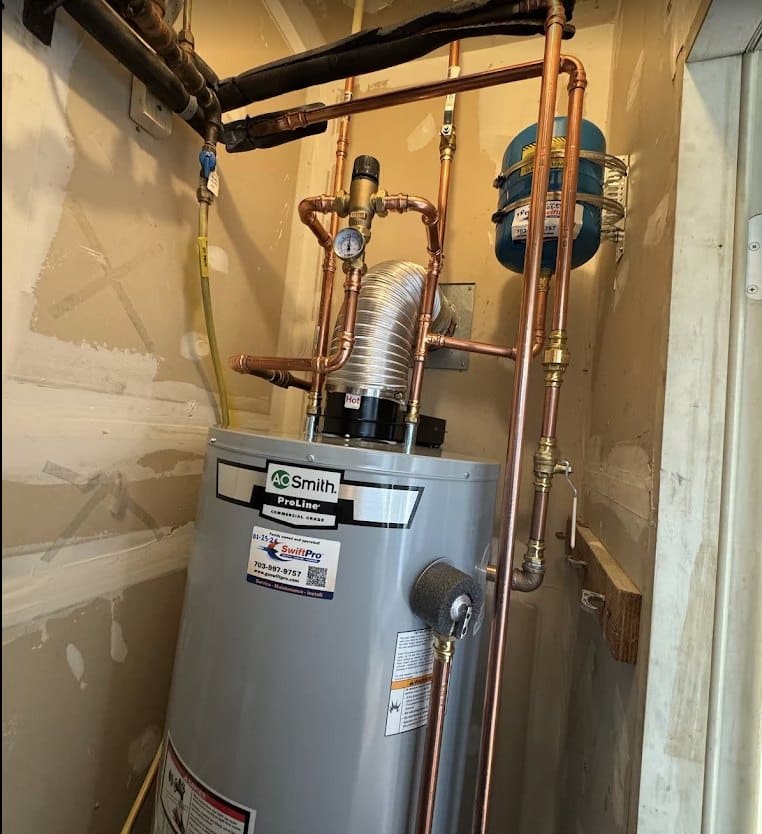
In 22102, which takes in Tysons, close to half of all homes are in buildings of 50 or more units, and more than four in ten owner homes there heat with electricity. In those towers the water heater is often an electric tank in a utility closet over a pan. Some buildings make hot water centrally instead, and then there’s nothing in the unit to flush; your management office knows which.