Stafford County Utilities makes its water from two lakes: Smith Lake, and Lake Mooney, which the County fills by pumping from the Rappahannock. Its 2025 water quality report prints no hardness figure, so nobody can honestly quote you a grains per gallon number for a Stafford tap. The first water out of your tank’s drain valve shows how much has settled, and that’s the best guide to how often yours needs doing.
The County flushes its own pipes, too, for a few weeks every fall and early spring, and this season’s main flushing runs from October 19 through the end of November 2026. It pushes sediment and rust out of the mains, and the County asks you to hold off on running water while crews work nearby, then run the cold tap until it clears. Discolored water drawn through a hot tap meanwhile lands in the water heater, so the sensible order is the County’s flushing first, then yours.
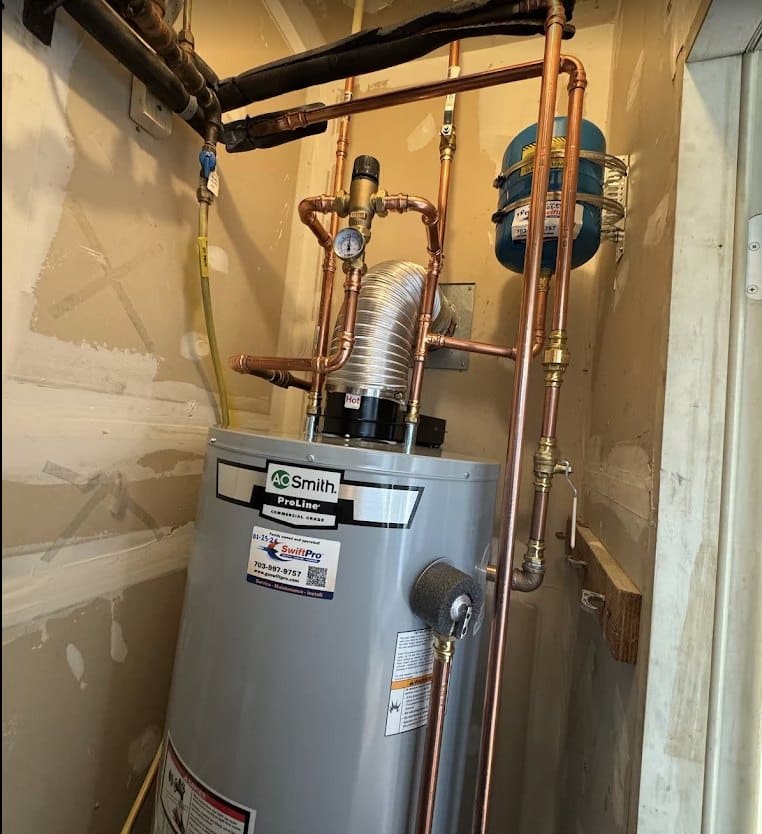
The pressure reading that comes with the flush has a Stafford reason behind it. The Utilities FAQ says pressure can spike from the water heater itself: heated water expands, a backflow preventer won’t let it push back toward the meter, and the gauge climbs. Above 80 psi the plumbing code wants a pressure reducing valve, at the owner’s cost if the builder skipped it. If ours reads high, you see the number before anybody suggests a fix.
Past the County’s water lines, Rock Hill’s older neighborhoods, Lake Arrowhead among them, sit on 1 to 3 acre lots with private wells; the County’s plan counts about 10,000 homes countywide on a well and septic tank. Well water is as hard as your own test says. And with most Stafford houses heated by electricity, most tanks here are likely electric, with an element down low where the grit piles up.