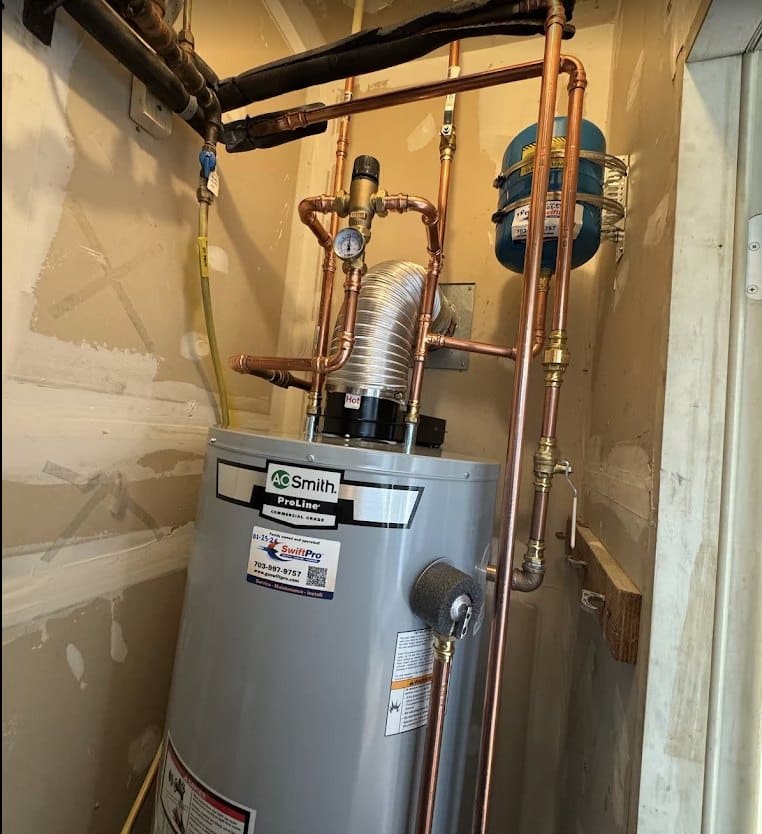
Every house with a 22027 address sits inside the part of Fairfax Water’s map served from the Washington Aqueduct. That’s Potomac River water, treated by the Army Corps of Engineers at its Dalecarlia and McMillan plants. The Aqueduct’s 2025 report puts its hardness between 96 and 187 milligrams per liter, about 5.6 to 10.9 grains per gallon, plenty of calcium to lay a fresh layer of grit on the bottom of a tank each year.
The figure moves with the river. It runs lowest in May and June and highest in December, which is the wrong month for a water heater: the water coming in from the street is near its coldest, so the burner runs longest on the hardest water of the year. NOAA’s normals for its Vienna station, 3.6 miles west, put the average January low near 23 degrees. A flush in the fall clears last year’s sediment before that stretch begins.
One corner drinks something else. Carnegie, Bucknell, Wesleyan and the other college-named streets off Cottage Street, with Vienna mail, buy Town of Vienna water, and the Town’s 2025 report calls it moderately hard to hard, 5 to 10 grains per gallon. Close enough that the advice doesn’t change: a yearly flush for a tank, and a yearly descale for a tankless that has no softener ahead of it.
The plumbing check that comes with every flush includes a pressure reading. Fairfax Water promises 20 psi at the main and nothing uniform past it, and the pressure reducing valve on the house side of the meter is the owner’s to keep up. In a house built around 1991 that valve may be the original. When one starts letting pressure creep up, it shows on the gauge before it shows as a dripping relief valve on the tank.