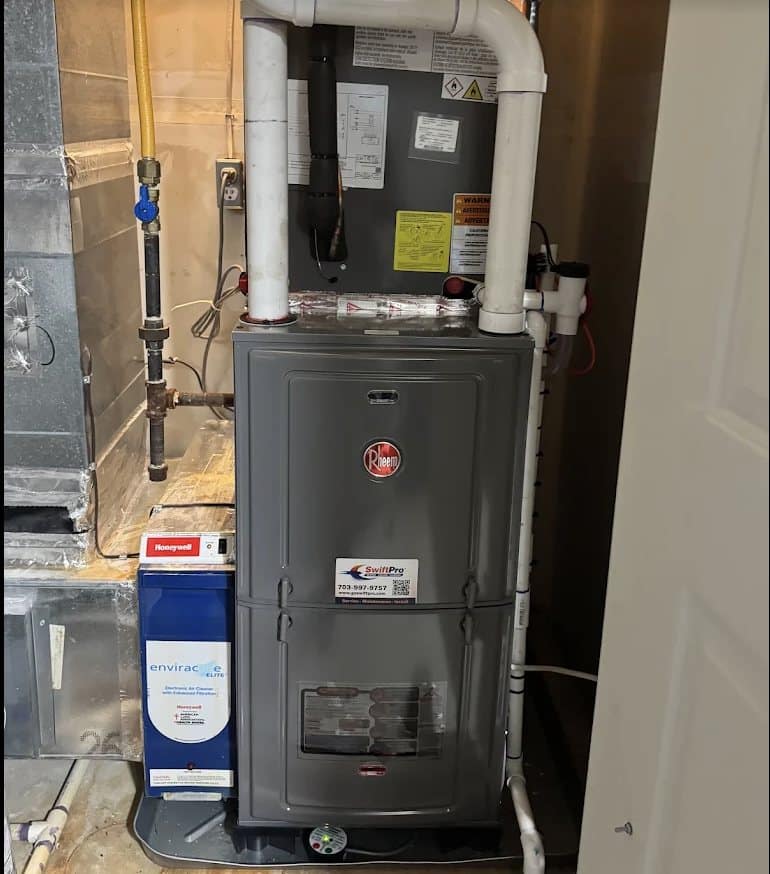
About three in four owner homes in 22101 heat with gas, and a house with nine rooms or more often splits the job between two furnaces: one in the basement for the main floors, one in the attic for the bedrooms. Each furnace is its own tune-up at $99. The attic one’s blower ran all summer for the cooling, but its burners haven’t lit since March, and the first cold night asks it to light, prove its draft and warm the bedrooms from a standing start.
If that attic furnace is a high-efficiency model, it makes water as it burns, and the small line draining it crosses attic air that falls below freezing on the coldest nights. When the water can’t get out, a safety switch stops the burners. That’s its job, and the reason a bedroom goes cold in January. Testing that switch with the other safeties is part of every tune-up.
McLean is where we see boilers most. Hot-water heat is a regular part of our McLean heating work, far more than anywhere else we go. A boiler is a different machine: no blower, no air to measure, and a fall visit built around the relief valve, the circulator pumps, the water pressure and the expansion tank. If baseboard or radiators heat your house, the boiler’s tune-up is the same $99 a system as a furnace’s; our boiler service guide covers what to check yourself first.
Tysons heats another way. More than four in ten owner homes in 22102 run on electricity, which in the towers usually means a closet heat pump with electric backup strips, tuned up for the same $99 a system. Most of the rest burn gas, often in a compact furnace fitted into a closet. Renting? Keeping the heat working is usually the owner’s job, so ask them first.