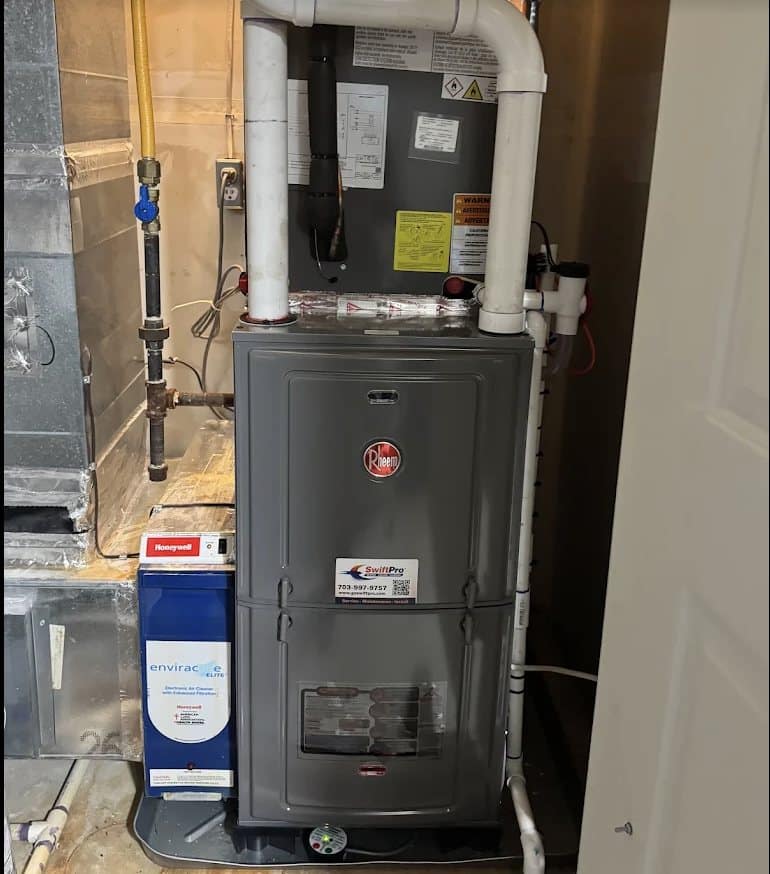
Pimmit Hills is the most gas-heated corner of the Falls Church address: about 9 in 10 owners there heat with gas, about three in four homes are single-family, and half its owner-occupied homes were up by 1961. Lake Barcroft follows at about 8 in 10, and the City and West Falls Church at about 7 in 10. In those houses the furnace usually sits in a basement or a utility room, and after sixty-odd winters it’s rarely the house’s first.
Pimmit Hills has a newer layer: close to a quarter of its homes have gone up since 2000, and inside the City it’s close to three in ten. A furnace from those years usually has a draft motor that must prove the vent is clear before the burners light, and more switches watching each step. The sequence of operation check follows it from a cold start through lighting, the blower kicking on and the shutdown, so a lazy step shows up in early fall, while a repair can wait for a mild day.
Older basement furnaces carry a summer load of their own: the air conditioner’s coil sits right on top, and every hour of cooling since May pulled dust into it. The heat has to push through that same coil, so temperature rise, the gap between the air coming back and the air going out, is the reading that matters most. Gas pressure is read against the rating plate, natural gas or propane.
Falls Church is one of the two places, with McLean, where boilers are a regular part of our heating work. A radiator house is no exception: a boiler that burns natural gas or propane is tuned up for $99 as well, and our boiler service guide walks through what that visit looks at. Bailey’s Crossroads goes the other way, with more than half its owners on electric heat, mostly heat pumps, and those are $99 a system as well.