Fauquier County’s building criteria set a winter design temperature of 17 degrees, the outdoor temperature a heating system here is sized to carry. NOAA’s 1991 to 2020 normals from Warrenton 3 SE, the nearest long temperature record, put the average January low near 25 and count about five nights a year at 10 or colder. Those nights run a system past its sizing, and that’s when a weak igniter or a tired blower motor gives itself away.
By degree days, a year here asks about four and a half times more of the heat than of the cooling. In late January 2026 an Arctic outbreak brought Extreme Cold Warnings to Northern Fauquier, and a weather station listed as The Plains, a few miles north of town, logged a wind chill of 6 below on February 1 and 5 below a week later. Wind chill is about skin, not houses, but that wind finds every gap.
About six owner homes in ten across 20198 heat with electricity, usually a heat pump. On nights like those it leans on its electric strips and reverses now and then to melt frost off the outdoor coil; the tune-up runs it through that sequence at the same price. The February 2016 ice storm left two to three tenths of an inch of ice across northern Fauquier. If freezing rain glazes the outdoor unit, never chip at the coil; if it won’t defrost, switch to emergency heat and call.
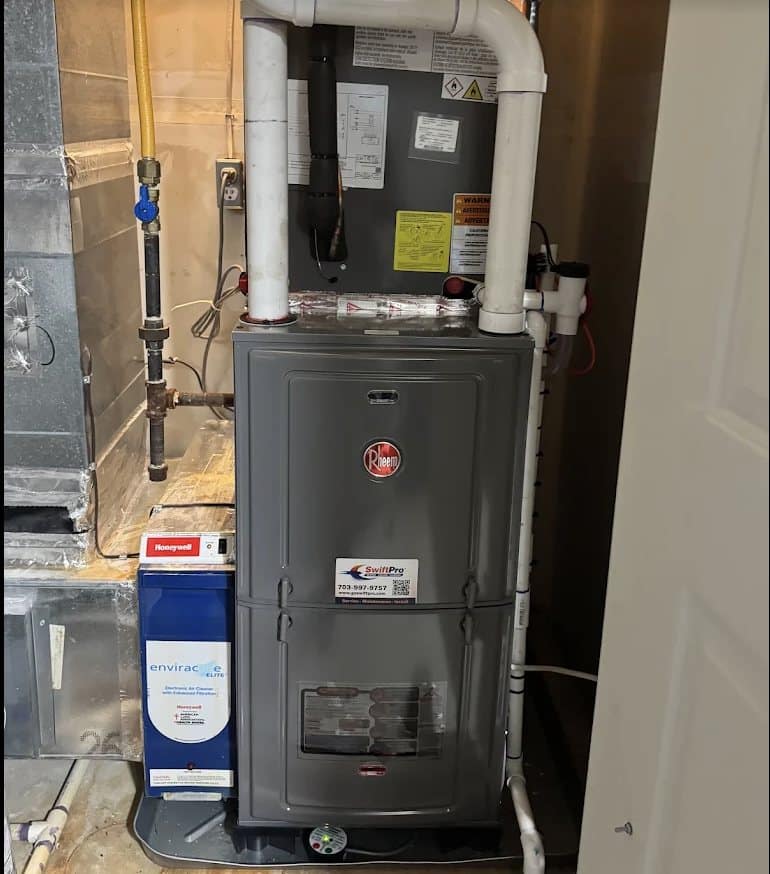
About one owner home in five heats with propane, and utility gas heats just 16 of the ZIP’s 589 owner homes, so gas heat here nearly always means a tank. Many newer ones vent out a side wall through two plastic pipes, and a drift over them shuts the furnace down. After a snow like the January 2016 blizzard, 24 to 36 inches across Northern Fauquier, clear those pipes first.