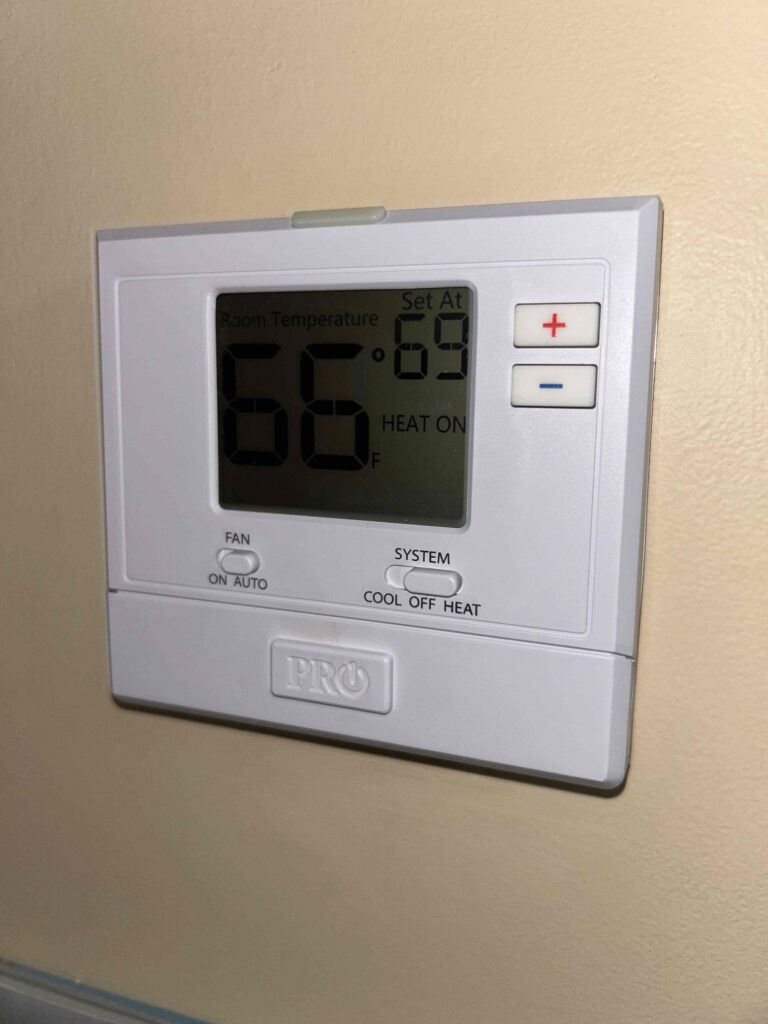
The weather station at the Marine Corps air station, 1.6 miles south-southwest of the Town at the river’s edge, averages 4,002 heating degree days a year. January there averages a low of 28 and a high of 45, and in half of all years the first freezing night has arrived by November 8. Most winters bring a couple of nights at 10 degrees or colder, the nights a furnace with a dirty flame sensor or a weak igniter quits. October is the month to find out.
Of the roughly 310 occupied homes the Census survey estimates in the Town, about 180 heat with natural gas and about 120 with electricity. Gas usually means a furnace, though a few of the oldest houses may still run a gas boiler feeding radiators, and a boiler tune-up is the same $99 a system. Electric heat usually means a heat pump, also $99.
By the same survey, about a quarter of the Town’s homes date from before 1940. A furnace in a house that old came long after the house, and it often vents up a masonry chimney shared with the water heater. The tune-up runs a full heating cycle and tests the switch that shuts the burners off when exhaust can’t get up the flue, which is where a crumbling liner or a nest in the chimney shows up.
Winter wind is the other test. The air station recorded gusts of 58 mph in February 2015 and 59 mph in February 2017, and in the December 2022 Arctic front, wind chills near the tidal Potomac fell to around 5 below. A gust that strong can knock a vent cap crooked, and a furnace that can’t vent shuts itself down. Before the season, walk outside to where your furnace’s pipes end: the roof cap sitting straight, side-wall pipes clear of leaves.