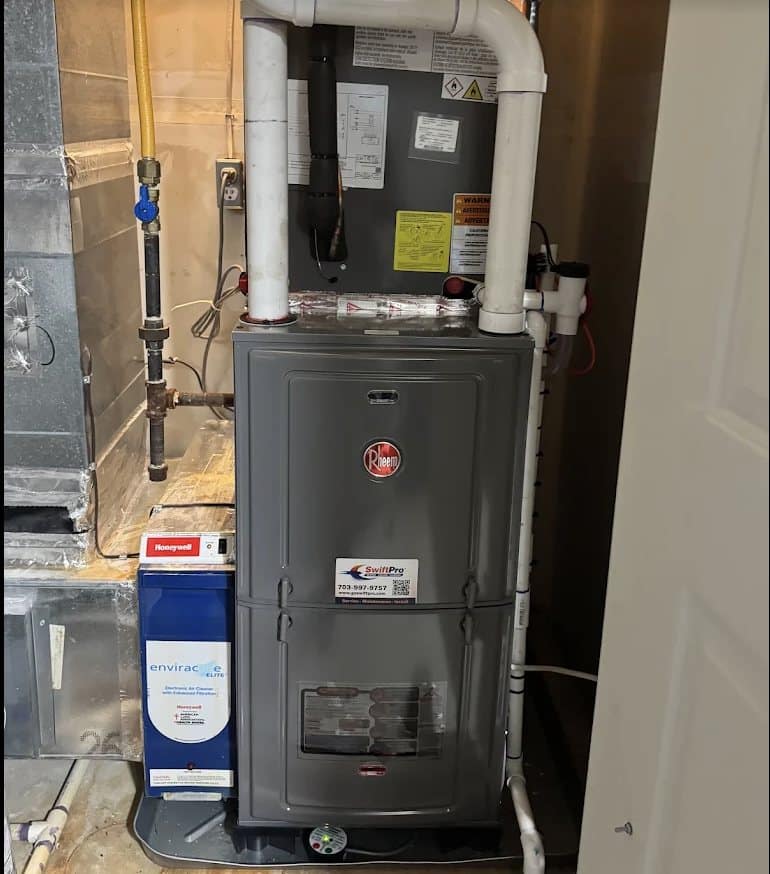
Inside the Town of Dumfries about four owner homes in ten heat with natural gas and a little over one in twenty with propane; about half heat with electricity, usually through a heat pump. The Town lists two gas companies, Columbia Gas and Washington Gas. Whichever one feeds your meter, the furnace’s own valve sets what reaches the burners, and that pressure, read with a gauge, is where the tune-up starts. Too low and the flame runs lazy; too high and the heat exchanger runs hot.
A propane house adds links to the chain: the tank in the yard and one or two regulators stepping its pressure down on the way to the furnace. The tune-up reads it at the furnace end, where it counts. New to a propane house? Find out whether the tank is yours or leased from the company that fills it.
The oldest houses in the Town sit on single-family streets like Whitehaven, whose houses Town records date from 1930 on, and Tripoli Heights, from 1950 on. A gas furnace in a house that age may still vent up a masonry chimney beside the water heater. The tune-up watches that draft through a full cycle, because exhaust that hangs at the furnace instead of rising is what the venting safety is there to stop.
In the townhouse rows, Williamstown and Port O’Dumfries among them, a gas furnace may sit in the attic. If it’s been swapped for a high-efficiency one that makes water as it burns, the drain line crosses an unheated attic, and a line that freezes on a hard January night shuts the furnace off. Cherry Hill, median owner home built 2005, has the most gas of the three places on a Dumfries address, seven owners in ten. Montclair is about half electric, and a heat pump there gets its fall tune-up at the same $99 a system as a furnace.