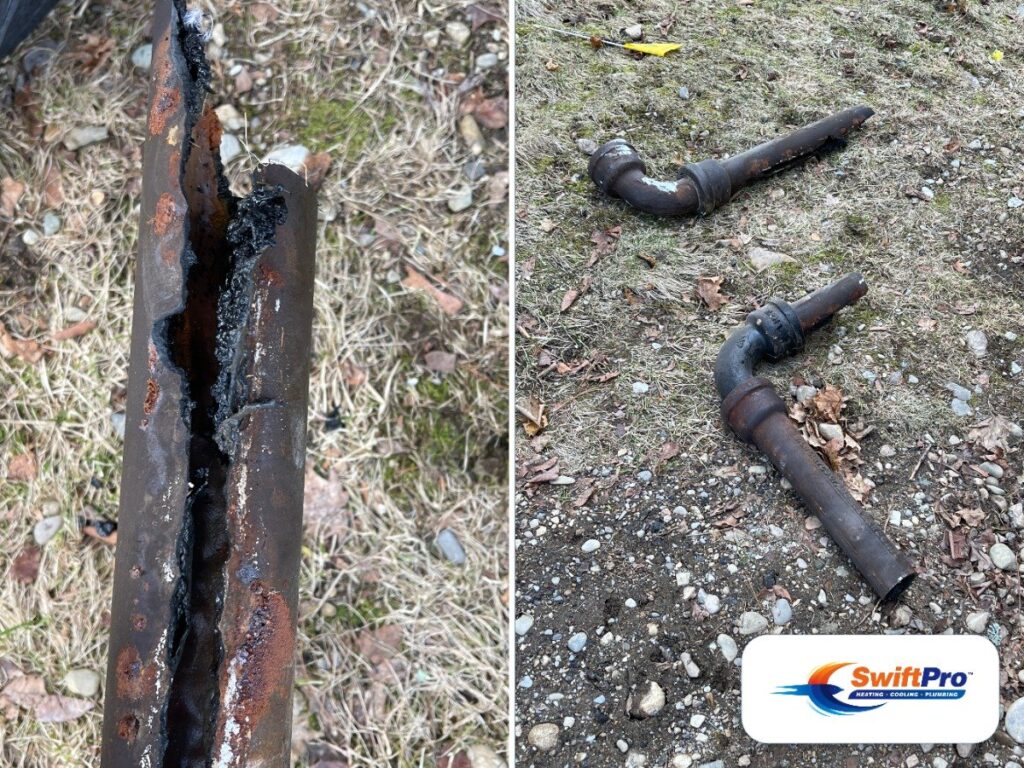
Inside the Town of Dumfries about one owner home in ten went up before 1960, most on the older single-family streets. Town records date the houses on Whitehaven from 1930 on and Tripoli Heights from 1950 on, with newer ones in between. A line laid that early is usually clay or cast iron, and a 1950s or 60s house may drain through Orangeburg, pressed tar paper pipe that loses its round shape over the decades. On those lots the camera goes in before any cable does.
Most of the Town is younger. Close to half its owner homes date from 1980 through 1999, the townhouse rows among them: Williamstown from 1974 to 1991, Port O’Dumfries from 1974 to 1988, South Cove from 1988 to 1992. By then the pipe to the street was usually plastic. It won’t rust, but the Town’s plan lists shrink-swell clay and seasonal wetness among the soil problems here, and ground that swells and dries around a pipe can shift a joint or leave a low spot.
Then there are roots. The Town’s plan puts its woods between Main Street and Prince William Forest Park, with more along Dewey’s Creek and Cannonball Run. Prince William Water lists roots getting in through cracks among the reasons sewer lines overflow, and the camera finds the joint they came in by.
Past the town line, Montclair’s houses are mostly 1980s and 90s, median 1989, and Cherry Hill’s newer still, median 2005, so the camera there is checking grade and joints on plastic pipe. Some older lots in and around the Town still drain to septic systems older than the public sewer, the Town’s plan says. SwiftPro does no septic work; these prices are for lines that run to Prince William Water’s sewer.