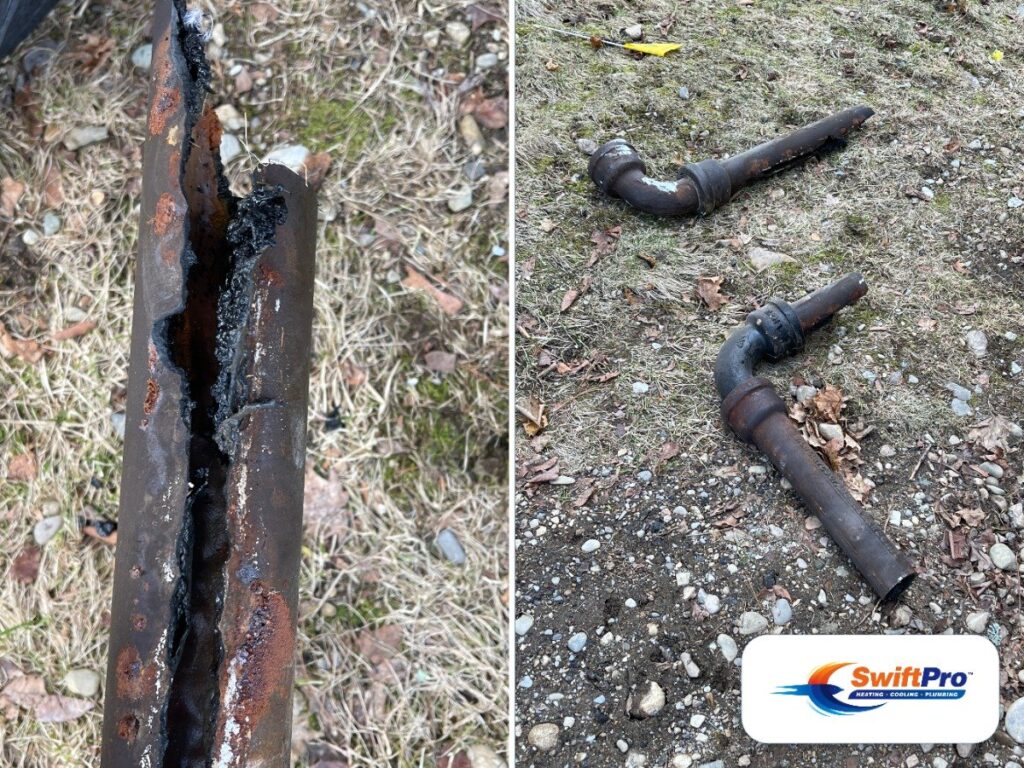
The County’s plan for Marshall counts more than 60 buildings from between the World Wars, and the Census puts about one home in seven in 20115 before 1940. Those houses are older than the Fauquier County Water and Sanitation Authority, first chartered in 1964, which runs the village sewer now. A drain that old has often been cut into more than once, so two or three kinds of pipe can meet between the basement wall and the main.
About 420 homes in the ZIP date from the 1940s through the 1960s, when some builders laid Orangeburg, a coal tar fiber pipe that loses its round shape with age and can come apart under a cable. With nothing on record about the line, a Marshall house from those years gets the camera before the cable.
North of Main Street, west of Rectortown Road, the County’s plan puts a neighborhood of cul-de-sacs built mostly in the 1970s to 1990s. The 1980s were the ZIP’s busiest decade, about 600 homes, and the median owner home dates from 1986. A line from the 1980s on is likely PVC, so the camera checks grade and joints: a run that sank in its trench and holds water, or a joint knocked out of line.
The ground is another reason to look before anyone digs. The County maps soils in parts of the service district with bedrock 20 to 40 inches down, where laying utilities takes ripping or blasting, and soils that shrink and swell. Moving ground works on pipe joints, and over rock, a hole in the wrong place is an expensive guess. We show you what the camera finds, and where, before anything gets priced.