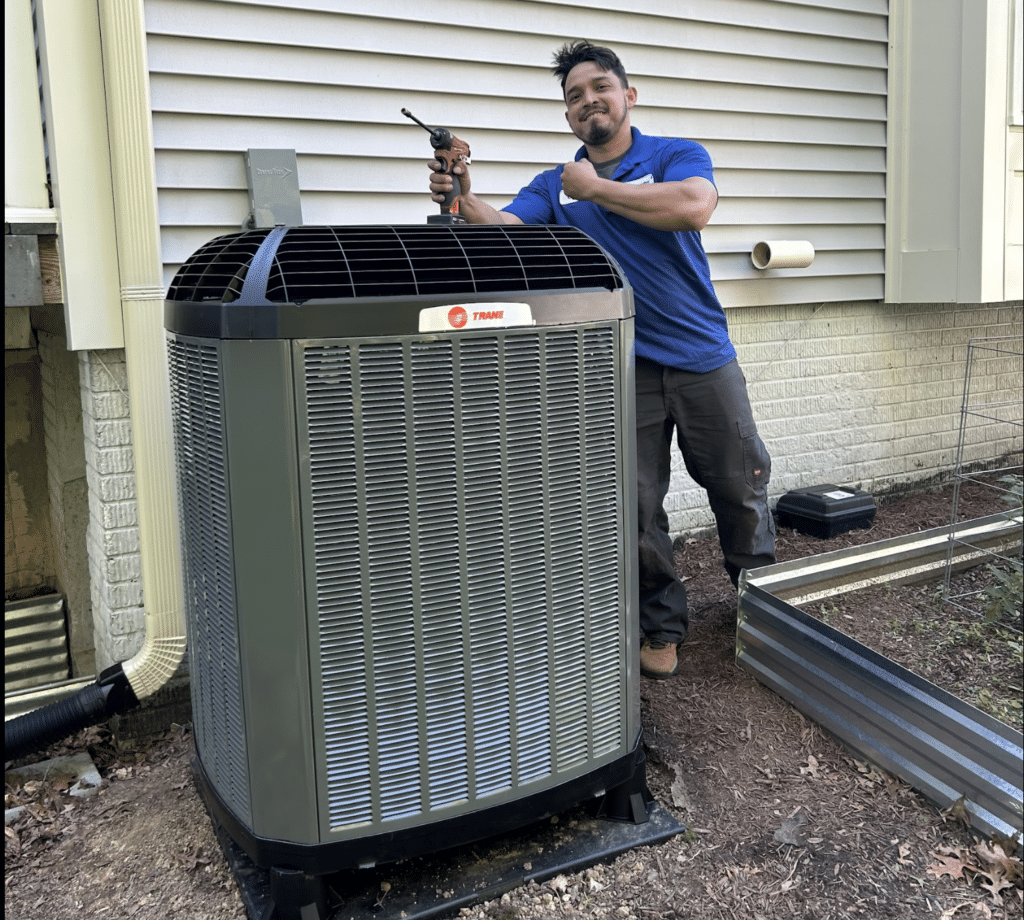
The Census never asks about heat pumps by name; it counts them as electric heat. In 20115 that’s 1,357 of the 2,109 owner homes, and 647 of the 849 rented ones, about three in four. With natural gas heating 8 owner homes in the whole ZIP, a heat pump here isn’t the alternative to a furnace; for most houses it is the heat. A replacement swaps both halves, the unit outside and the air handler with its backup strips, and keeps the ducts.
About one owner home in five burns propane, and in plenty of those the heat pump’s indoor coil sits on the furnace, which takes over on the coldest nights. Replacing that heat pump leaves the furnace in place; what gets redone is the handoff temperature in the thermostat, set for what the new outdoor unit can carry rather than copied from the old one’s settings.
Wood is the main heat in 160 owner homes, about one in thirteen, and in some of them the heat pump mostly cools. Sizing from the old nameplate misses twice in a house like that: the heat pump may only need to cover spring, fall and the rooms the stove never reaches, or it may have to carry the whole house the week nobody’s home to feed the stove. Say which when you book.
The old village is the hard case. An I-house on Main Street or a story-and-a-half frame house on Anderson Avenue went up long before central air, and its ducts were often threaded in later, wherever they’d fit. A heat pump moves more air than a furnace, at a gentler temperature, so we measure those runs before quoting; a cramped retrofit duct is often why the upstairs never warmed up.