The Census counts a heat pump as electric heat, and by that measure Burke is half heat pump country: just over half of its owner-occupied homes heat with electricity, which here mostly means a heat pump. Burke Centre has the higher share, about 7 in 10. But the Burke Census place around Lake Braddock has about two and a half times as many owner homes, so its roughly 4 in 10 adds up to more houses: about 5,200, against about 3,400 inside Burke Centre. A heat pump job in Burke is as likely to be a 1970s single-family house as a Burke Centre townhouse.
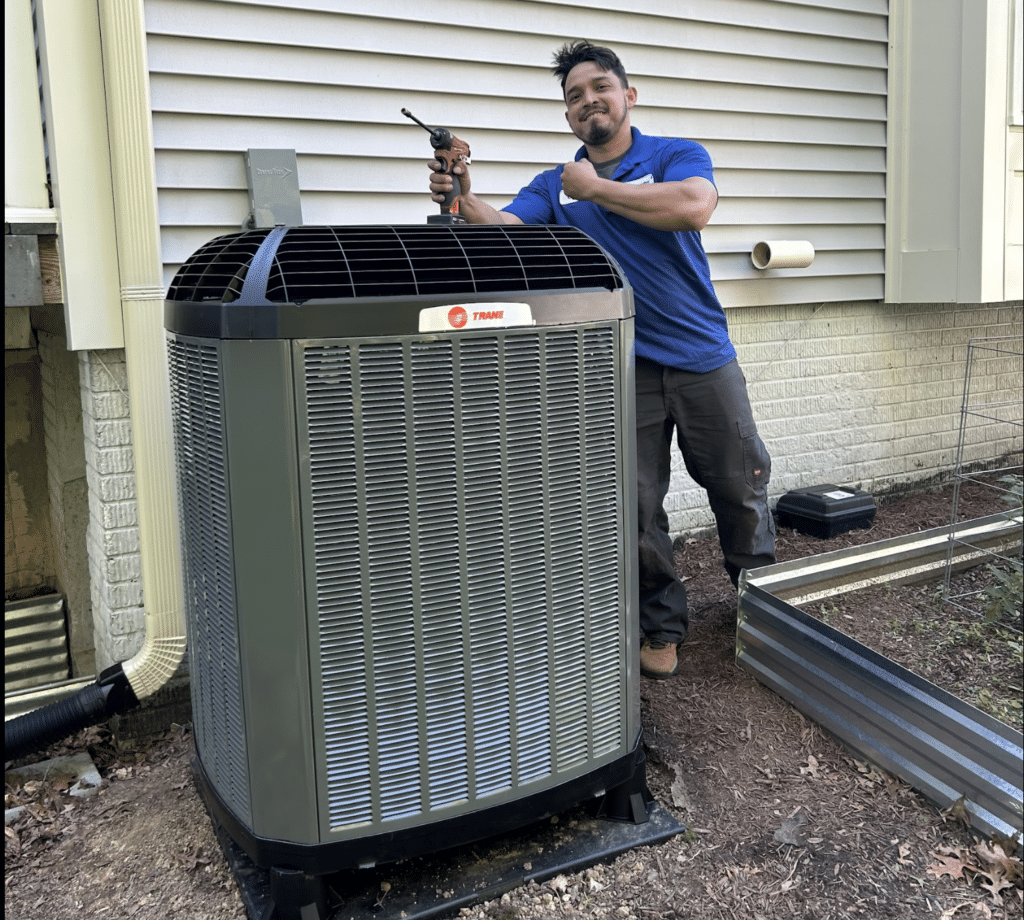
In a Burke Centre townhouse the outdoor unit sits on a pad behind the row, often a few steps from the neighbor’s, with the air handler and its electric strips in a closet or utility room. A like unit back on the same pad needs nothing from the Conservancy. A different spot, or a second unit, takes an approved application, and the Conservancy asks for the new unit’s dimensions, color and decibel rating with it.
Outside Burke Centre a little over half the owners burn gas, and in those houses a heat pump usually takes the old air conditioner’s spot on the pad, wired to the furnace inside. It carries the heating until the weather turns properly cold, then hands off to the gas; our dual fuel guide walks through how that works.
Burke Centre is also 65 clusters, and the Conservancy’s standards let a cluster add supplemental rules of its own. If a new heat pump won’t go back exactly where the old one stood, ask the Conservancy office about your cluster’s rules before you choose the unit, and in a condo building, about 1 in 8 of Burke Centre’s owner homes, ask the condo association too.