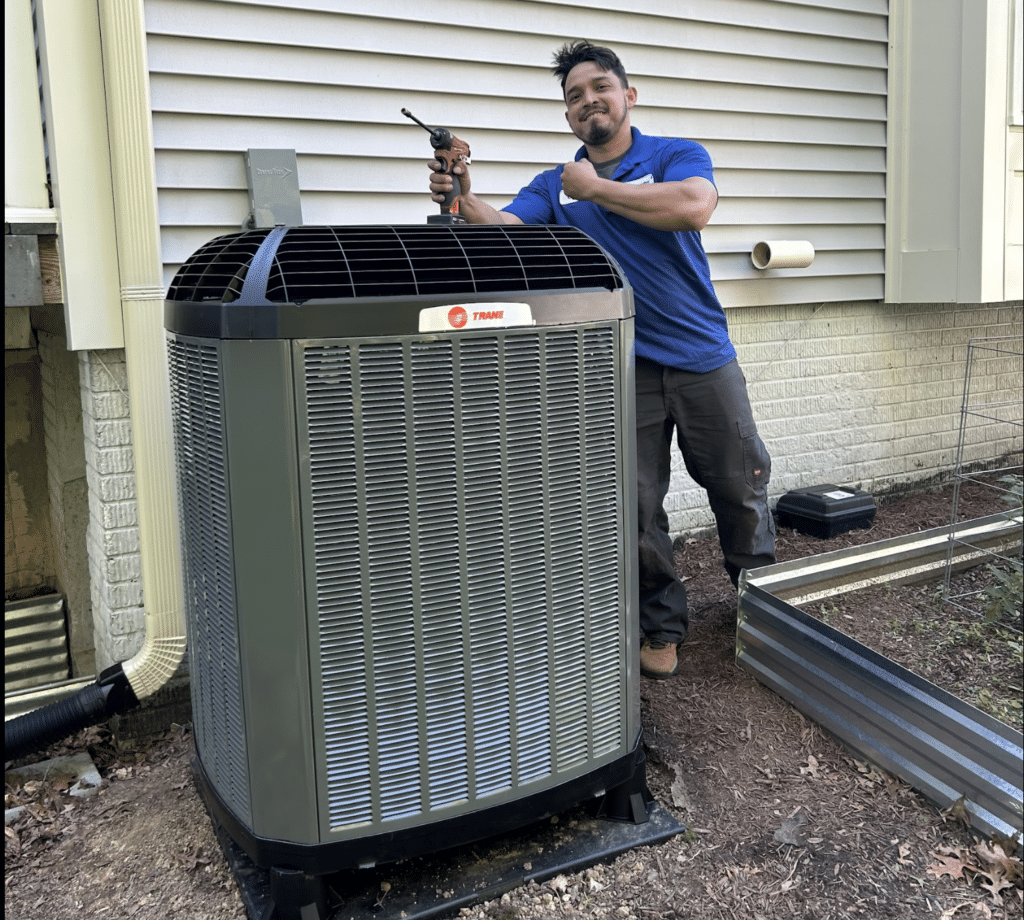
Electricity heats about 39 in 100 owner homes in Great Falls, by the Census count, a little more than the 35 in 100 across Fairfax County. Out here that usually means heat pumps, and in houses this size, often more than one: an outdoor unit for the lower floors and another for the bedrooms, each with its own air handler and its own bank of electric heat strips as backup. Replacing one doesn’t commit you to the other.
A heat pump runs winter and summer, so it wears out sooner than an air conditioner that only cools, and fifteen years or so is a fair run. Half the houses in 22066 went up in the 1970s and 80s, which puts the all-electric ones on their second outdoor unit at least, and many on their third. A worn one gives itself away on the coldest mornings: the house stays warm, but the thermostat shows aux heat on more and more.
In the other half of town the furnace burns natural gas or propane, and a heat pump can still earn its place. Set where the air conditioner sits, it cools all summer, heats through the mild part of winter, and hands off to the furnace when it gets properly cold. That’s dual fuel, and in a propane house it means the furnace, and the tank, only carry the coldest stretches. Our dual fuel guide explains how the handoff works and where it gets set.
Backup heat matters more in a big all-electric house. Each air handler carries strips rated in kilowatts, and with two systems in a 4,000 square foot house, they can lean hard on the electrical panel on a cold morning. A replacement is the time to check that the breaker and the wire feeding each air handler match the strips going in.