Fewer than one owner home in a hundred in 20115 heats with natural gas. About six in ten use electricity and one in five propane from a tank in the yard, so the heater is usually one of those. A propane tank heater adds the gas connection and the flue or power venter, and prices on the gas or propane row.
Marshall has no town government, so permits come from Fauquier County’s Department of Community Development on Courthouse Square in Warrenton, and the rule turns on fuel. Anything fuel-fired takes a permit, so a propane heater does even as a straight swap. An electric heater replaced with a similar model in the old one’s spot needs none; relocating either kind does. The County hands out trade permits the same day you walk in.
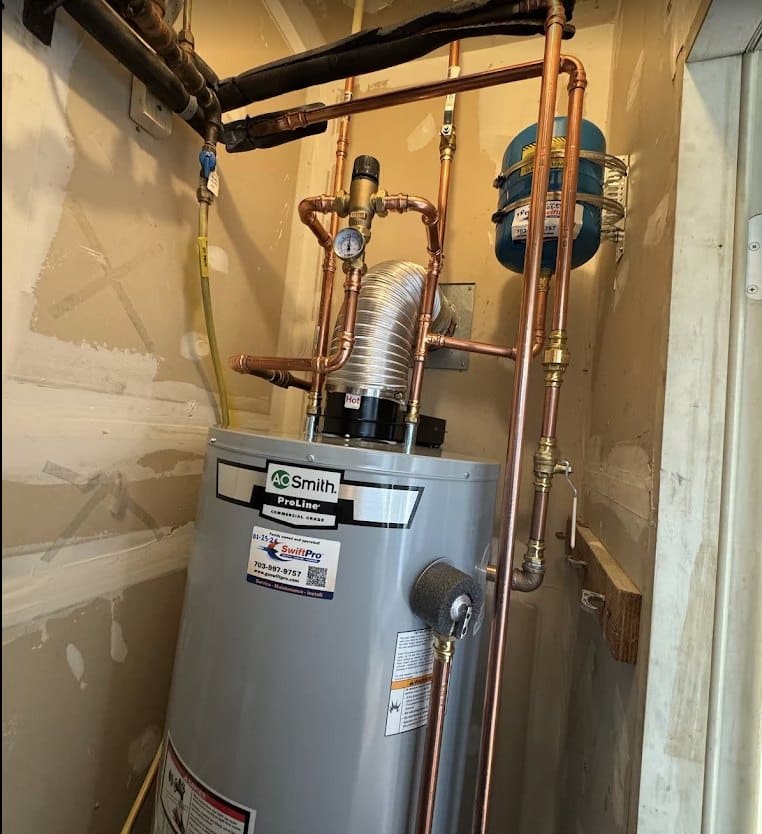
Some of FCWSA’s Marshall wells carry iron and manganese, which settle in a tank with other sediment and, on an electric heater, bury the lower element first. FCWSA owns the line through the meter box; past it, the pipe and the heater are yours. Above 80 psi, FCWSA tells customers to fit a regulating valve at their own expense, and with one in, the water a heater warms can’t push back toward the main. So an expansion tank comes with every heater we install.
Outside the service district the house runs on a private well, permitted by the Fauquier County Health Department. Virginia Cooperative Extension’s clinics found acidic water, below pH 6.5, in close to half the Fauquier well samples, and it eats at a tank’s anode rod and at copper fittings. The pressure tank and pressure switch belong to the well contractor; the heater and everything after it are ours.