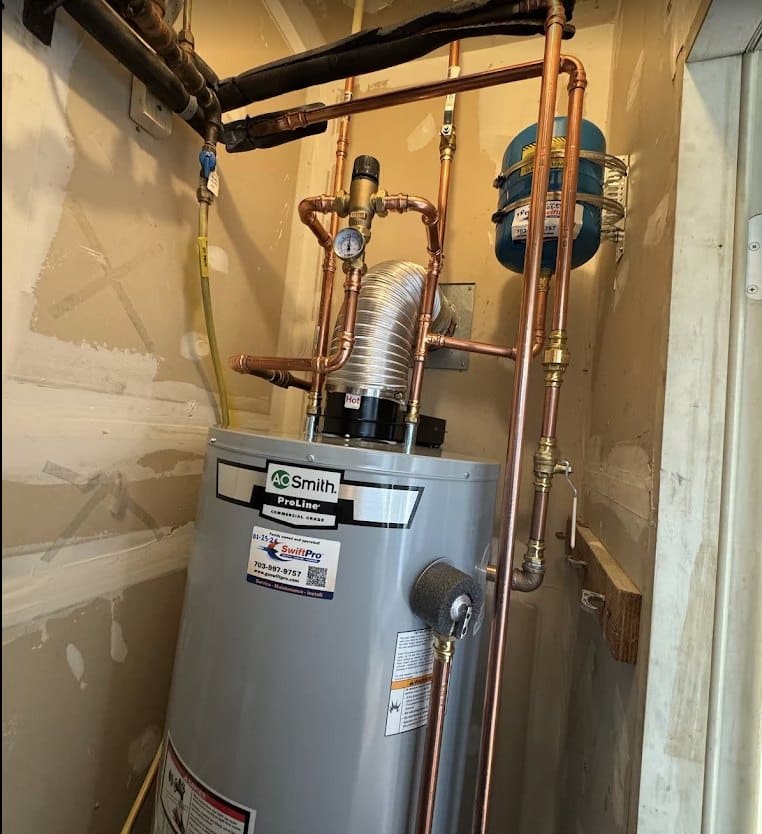
Not one owner home in ZIP 20119 heats with natural gas, by the Census count. Electricity heats 526 of the 1,040 and propane 301, and the water heater usually burns or draws whatever heats the house: two elements and no flue beside a heat pump, a burner, a gas control and a flue where propane feeds the furnace, priced on the natural gas row at $3,379 to $5,485. The County permits them differently; see below.
Close to 180 homes in the ZIP predate 1940, some in the old railroad village, and about 470 were built in the 1990s and 2000s out among the farms. In the oldest, the plumbing came after the house, so the heater sits wherever it fit: a stone cellar, a closet off the kitchen, a closed-in back porch. In the newer ones it’s usually in the basement near the well’s pressure tank, and one that came with the house has outlived the usual run of a tank.
Inside the village, FCWSA’s little Catlett system serves about 74 hookups from two bedrock wells; its pressure advice is below. Everywhere else the house has its own well, and the well, the pump down in it and the pressure tank belong to a well company. What a well can do to a water heater is send it sand and grit, which settles on the bottom and buries an electric tank’s lower element.
The Weather Service gauge on Cedar Run near Catlett crested at 18.2 feet on July 12, 2013, third on its list of record crests, the same day flash flooding closed roads in Catlett, and it topped its 15 foot flood stage again in April 2014 and July 2025. At 21 feet, the Weather Service says, the Route 806 bridge goes under and water reaches buildings nearby.