Warrenton has two building offices, both downtown. Inside the town limits the Town of Warrenton runs its own, in its Department of Community Development, and a water heater permit there comes from the Town, not the County. Outside the limits, Fauquier County’s building office on Courthouse Square takes over. The envelope says Warrenton either way, so the first thing to settle on a replacement is which side of the line the house is on; each office’s rule is further down this page.
Inside the town about six in ten owner homes heat with gas, so the tank is usually gas too, and the swap is permitted work. The median owner home went up in 1993, but nearly three in ten of the town’s homes predate 1960, and in those the water heater often shares a masonry flue with the furnace. If that furnace has been swapped for a high-efficiency model that vents out the side wall, the tank is left alone on a flue sized for two, and that gets checked before a new tank goes on it.
Out in the county the water feeding the heater changes. New Baltimore and Vint Hill are on Fauquier County Water and Sanitation Authority systems that draw from drilled wells, and the Authority’s 2025 report says iron and manganese in the New Baltimore wells can tint the water brown. Beyond the service districts, homes run on their own wells, and Virginia Cooperative Extension’s Fauquier well clinics, 2012 to 2017, found water under pH 6.5 in 46 percent of samples. Water that slightly acidic is harder on a tank’s anode rod, the part that corrodes so the steel doesn’t.
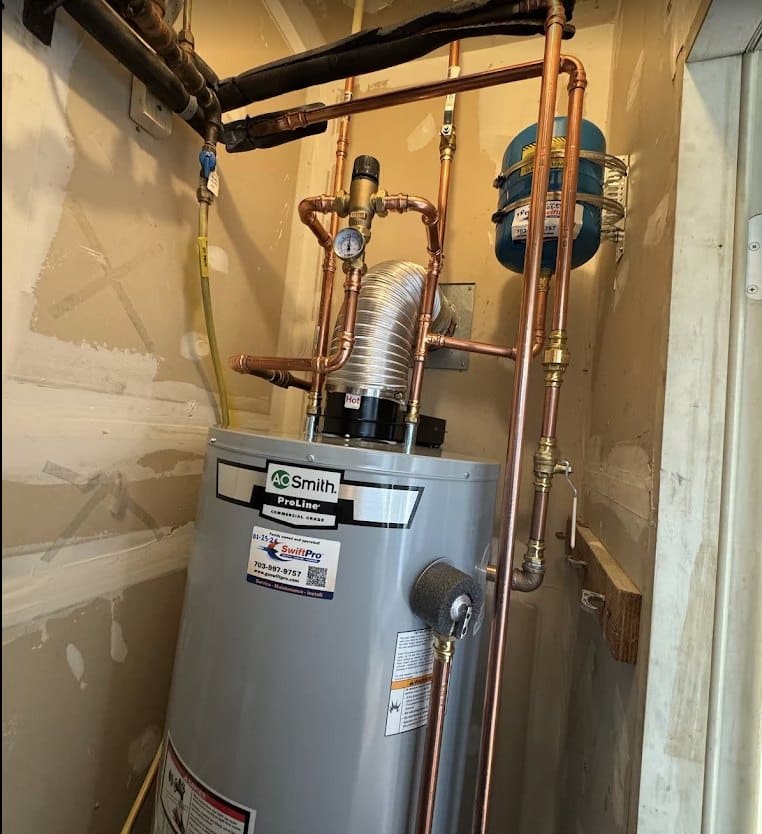
Pressure is the other county wrinkle. FCWSA’s rules leave everything past the meter box to the homeowner, and say a house above 80 psi should have its own pressure regulating valve. Once that valve is in, heated water has no way back to the main, and the expansion tank already in every price we give is where it goes. On a well, the pressure tank and its switch set the house pressure.