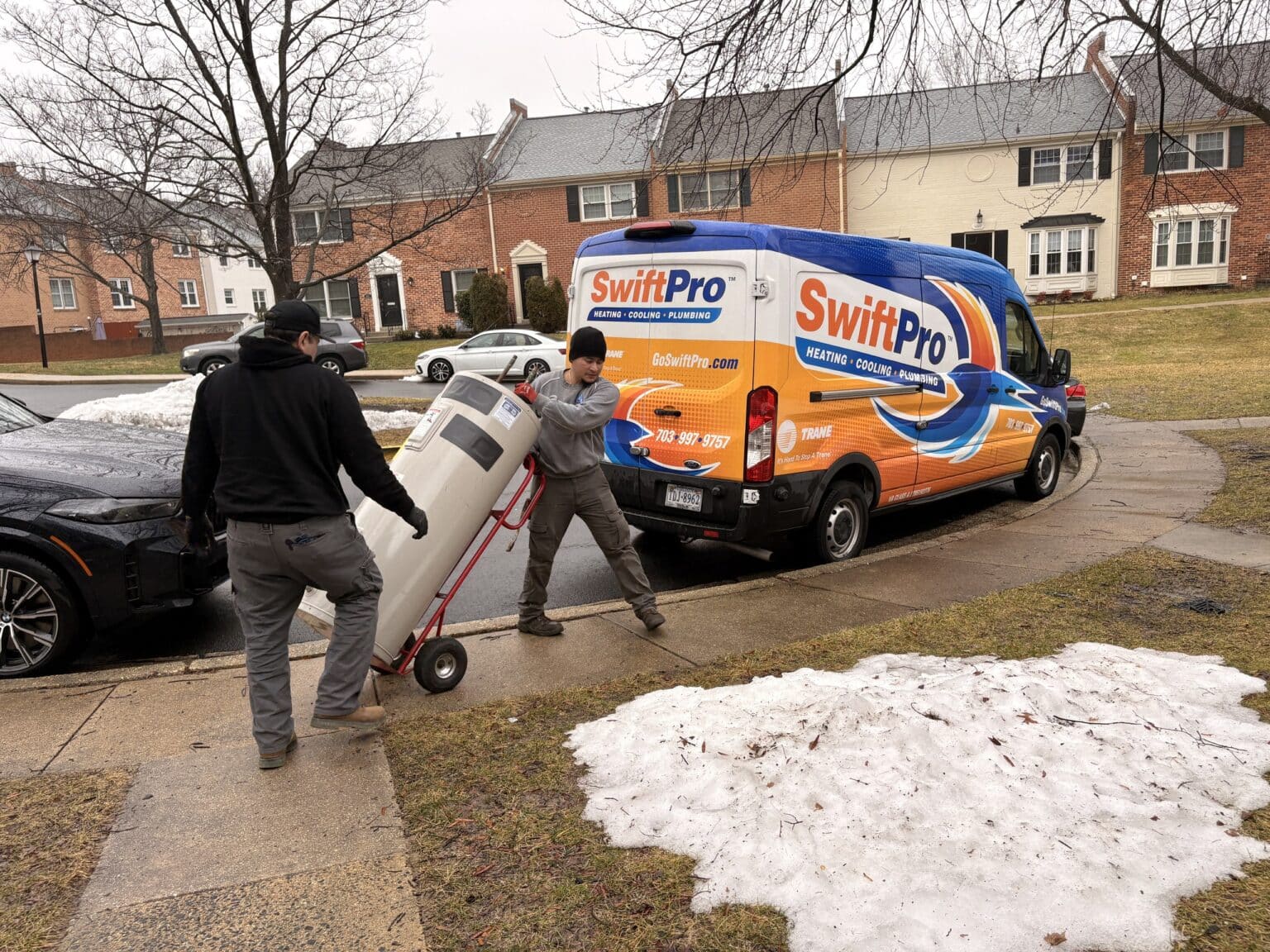
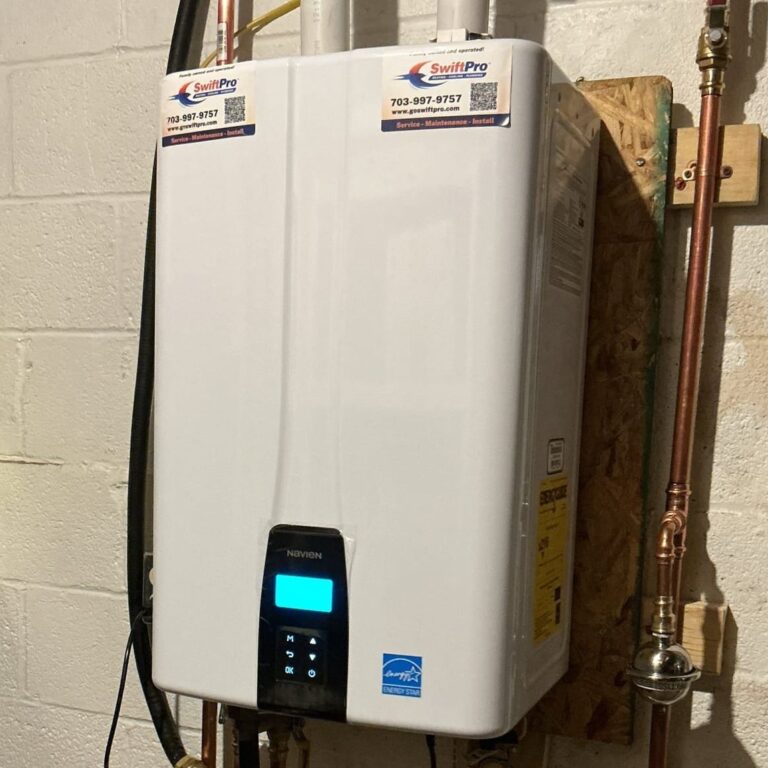
With close to three quarters of Centreville homeowners heating with gas, most water heaters here burn gas too. In a townhouse the tank often stands on the lowest level beside the furnace, sometimes in a closet higher up; in a single-family house it usually shares the utility room with it. The median home went up in 1990, so the tank you have now is rarely the builder’s. It’s the second or third, and the date on its label says how far along this one is.
Watch the flue. Houses of this age usually started with the furnace and the water heater sharing one metal flue. When the furnace was swapped for a high-efficiency model venting out the wall in plastic, the water heater was left alone on a flue sized for both, and a small tank on an oversized flue can draft poorly. The fix is a liner sized for the water heater, or a power vent tank, $5,957 to $7,494 installed, which pushes its exhaust out a side wall through its own pipe.
About a quarter of homes here heat with electricity, and their water heaters are usually electric too. Fairfax County’s appliance permit page is plain about gas: a gas water heater needs a permit and a chimney vent certification even like for like. Converting to tankless with new gas piping makes it a residential plumbing permit instead. On an electric tank the county’s own pages don’t agree, so we don’t promise a swap goes without one. Where a permit is needed, gas or electric, ours is in the price.
Pressure is the other thing wearing on these tanks. Almost every Centreville house went up after Fairfax County started requiring a pressure reducing valve in 1972, and that valve closes the house off from the street, so heated water has nowhere to expand but the tank and its relief valve. That’s what the expansion tank in every replacement we price is for, and why a weeping relief valve here earns a pressure reading.