It keeps running days after the rain stops
On flat, slow-draining ground that’s normal for a day or two. A pump cycling every minute with the pit nearly dry, or never catching up as the water nears the rim, needs replacing before the next storm.

Open 24/7 for emergencies

Sump pump replacement in Catlett: $697 installed in your existing pit. A new pit, a battery backup, outside drain work or new wiring is extra.
Get your price in writing
Send this and the office calls or texts you back to set a time.
We’ll call or text this number about your request. By sending it you agree to our terms and privacy policy.
Rather talk now? (703) 997-9757
5.0 stars across 1,132 reviews
Two of our technicians in a basement mechanical room, beside the furnace and a gas water heater.
Licensed and insuredVirginia Class A contractor #2705192276
24/7 emergency serviceOften same-day, and we will tell you honestly when we can get there.
Our own plumbers, our own trucksNobody here is a subcontractor with a magnet on the door
The price is settled before the workYou see the number in writing before anything is taken apart
What it costs
The same price as our sump pump replacement page: one flat number for a new pump in a pit that’s still sound, with what costs extra named right beside it.
Sump pump replacement, installed in your existing pit
$697
Sump pump and battery backup, installed together
$3,200
or $53/mo at 0% APR for 60 months
A new or deeper pit, discharge line work outside, or a dedicated circuit
Priced in writing before we start
Monthly figures: 60mo @ 0% APR on each starting price, the whole price financed, on approved credit. Longer plans lower the payment and cost more in total. The lender sets the final terms. How financing works
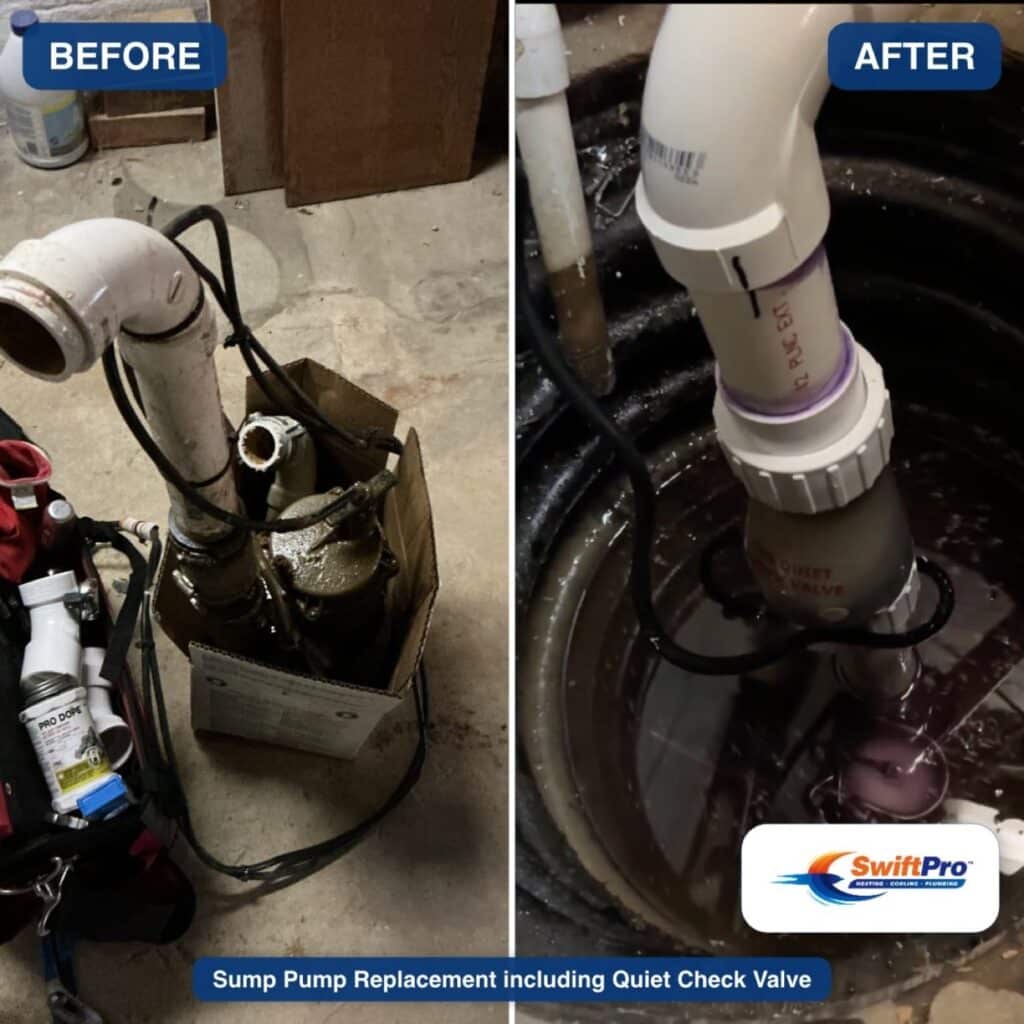
$697 covers a new cast iron pump, a quiet check valve, new PVC up to your existing discharge line, a battery water alarm by the pit, the old pump hauled away and a bucket test before we leave.
A battery backup keeps pumping through a power outage, and the outage usually comes with the storm. With a new pump, the pair is $3,200 installed. The sump pump estimator helps you decide whether you need one.
What’s different in Catlett
Nobody publishes a count of Catlett basements; the Census doesn’t ask. It does show a ZIP of detached houses only, 1,415 of them, with the 1990s the busiest decade at about 270 homes. A basement from then usually has a pit poured with the slab and, by now, a pump that isn’t the builder’s. The 180 or so homes from before 1940 may have a cellar, with any pit added later.
The County calls the Culpeper Basin under Catlett nearly flat, and the “blackjack” soils that ruined drainfields here for decades are tight. Soil that won’t take a septic field’s water usually doesn’t take rain quickly either, so water beside a foundation waits for the footing drain to carry it to the pump.
The National Weather Service’s gauge on Cedar Run near Catlett puts minor flooding at 15 feet, when water nears a low spot on Flatwood Lane; at 21 feet the Route 806 bridge floods and water gets into buildings nearby. The creek reached 18.2 feet in July 2013, when flash flooding closed roads in Catlett, and 15.91 feet in July 2025 on the preliminary reading. In November 2020 flooding closed Elk Run Road near Tenerife Road.
A sump pump has limits there. It keeps groundwater rising under the floor from becoming a wet basement; it can’t hold back a creek coming in over the ground. Once floodwater drops, a pump that ran for hours or sat underwater deserves a test.
By the numbers
From the Census Bureau’s 2020 to 2024 survey, owner-occupied homes unless it says otherwise.
ZIP 20119 as a whole: every Catlett address, the village included. The Census place for the village alone has too few homes for steady figures.
When it’s time
On flat, slow-draining ground that’s normal for a day or two. A pump cycling every minute with the pit nearly dry, or never catching up as the water nears the rim, needs replacing before the next storm.
Zoeller, who make a lot of the pumps around here, puts a sump pump’s life at seven to ten years. Past seven, replace it on your schedule instead of the storm’s.
Water is running back into the pit through a check valve that no longer closes, so the pump moves the same water again and again until it wears out.
After a heavy rain
Six checks you can make yourself once the rain lets up, none of them with your hands in the pit. Then call us and we’ll check it all.
Watch the pit during the rain or right after. The pump should start as the water rises, empty the pit and shut off. A full pit, or a pump that hums and moves nothing, isn’t keeping up.
Walk the basement: the corners, the walls, the floor by the pit, under the water heater and the furnace. Photograph any wet spot before you mop, so we can see where it came in.
Outside, find where the pump’s pipe ends. It should be open, not crushed, buried or full of leaves, and aimed away from the house so the water doesn’t run back to the foundation.
Listen when the pump shuts off. Water rushing back into the pit means the check valve isn’t closing, and the pump has to move that water again.
The pump stops when the power does, often at the height of the storm. If the basement took water during an outage, that’s the job a battery backup does.
If water is standing near the pit, an outlet or anything plugged in, don’t wade in to check. Call us, and only switch the power off at the panel from somewhere dry.
Not sure what you saw? Call us after a storm and we’ll check it all: the pump, the float, the check valve, the discharge line and where the water came in. If the pump can’t keep up, a new one is $697 installed in your existing pit; a new or deeper pit, a battery backup, discharge line work outside and a dedicated circuit are extra, priced in writing before we start.
Choosing who replaces it
Questions to ask anybody who quotes you, us included.
Neither should ever take sump water, and a plumber who doesn’t ask may tie the discharge into the nearest floor drain.
Ask what the number covers: the pump, the check valve, the pipe, hauling the old one off, a test before they leave. Then ask what costs extra, and get it in writing.
Cast iron, ideally. Plastic pumps cost less and are usually the ones that quit early. Ask before the old one comes out.
A discharge line that’s cracked, buried or frozen shut every January leaves the new pump pushing against a closed pipe. Whoever replaces it should check the outside end too.

Two of our crew going over a work order before the day's calls.
From our Google reviews
5.0 stars across 1,132 reviews. Read them on our reviews page.
Replaced 2 sump pumps. Very professional, proficient, and courteous.

Where we work
Next door to Catlett: Calverton, Casanova, Midland, Nokesville and Bristow.
Questions
No. The County’s STEP guide names roof drains and floor drains among the connections it prohibits and asks owners to keep rainwater out. Sump water goes outside, well clear of the house and the tank.
No. The operator keeps up the County’s STEP tank, its pump and its panel. Under the County’s sewer ordinance everything else on the lot is the owner’s, the sump pump included, along with the power both pumps run on.
Power first: wind is the other half of Catlett’s storm record. NOAA logs gusts estimated at 75 mph in August 2021 that downed trees on Old Dumfries Road, and the March 2018 windstorm swamped Fauquier’s 911 center with calls about trees and wires down. With the power out, the sump stops, and so does a STEP tank’s pump, so go easy on water. Once it’s back, check that the sump restarts and the STEP panel is quiet; an alarm is the County operator’s, at 540-325-0748. Then call us to check the pump, the float and the check valve. If it can’t keep up, a new one is $697 installed, or $3,200 with a battery backup.
$697 installed in your existing pit: a new cast iron pump, a quiet check valve, new PVC to your discharge line, a battery water alarm, the old pump hauled away and a bucket test. A new or deeper pit, discharge line work outside, a battery backup and a dedicated circuit are extra, priced in writing before we start. A new pump and a battery backup installed together are $3,200.
Yes. Pour five gallons of water into the pit. The float should rise, the pump should start within a few seconds, and it should shut off clean once the water’s down. If you hear water rushing back into the pit after it stops, that’s the check valve.
Ready when you are
Call, or send the form at the top. Often same-day, and we will tell you honestly when we can get there.
SwiftPro Heating, Cooling & Plumbing
4230 Lafayette Center Dr N, Chantilly, VA 20151
44679 Endicott Dr, Suite 211, Ashburn, VA 20147
Virginia Class A contractor license #2705192276
SwiftPro Heating, Cooling & Plumbing is a licensed, BBB Accredited (A rating), independently owned heating, cooling and plumbing company in Chantilly, serving Catlett and the rest of Northern Virginia. Virginia contractor license #2705192276. 5.0 stars across 1,132 reviews on Google, Angi, Yelp, the BBB and Facebook. SwiftPro maintains a dedicated HVAC team and a dedicated plumbing team.
From SwiftPro Heating, Cooling & Plumbing in Chantilly. Housing figures are the Census Bureau’s American Community Survey, 2020 to 2024, for each place named; permit, water and sewer facts link to each office’s own page and were checked in September and October 2026.