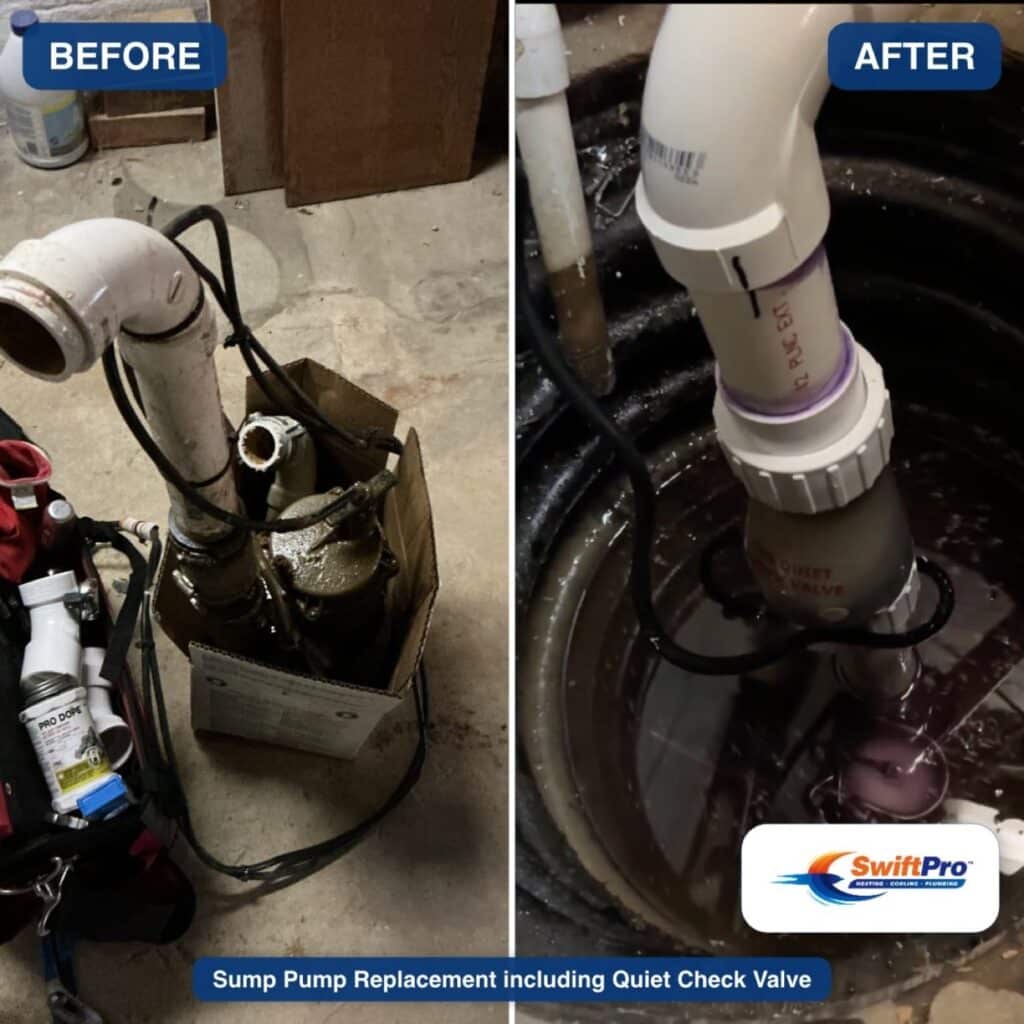
Start with whether you have a pit at all. More than half the homes inside the City of Alexandria are in condo and apartment buildings, where a sump, if there is one, sits in the building’s lowest level and usually belongs to the association. The City’s single-family houses and rowhouses are where owners keep their own. Where the house has a backflow preventer on its sewer line, nothing that flows, sump or downspout, can tie in upstream of it: the valve shuts during a sewer overload, and the pump would be pushing into a closed pipe.
The Fairfax County side sits on different ground. The county’s homeowner guide puts its marine clay mostly east of Interstate 95, and its soil and water district names Franconia and Hybla Valley among the hotspots. Water soaks into that clay so slowly it stands in flat yards, and thin sand layers inside the clay carry groundwater; where one runs near a basement wall, the guide warns, the basement can get badly wet. Its fix runs the foundation drain to a slope or a sump pump, and says a pump the basement depends on should be kept in good working condition.
Fort Hunt, Mount Vernon and Rose Hill are mostly single-family houses, and the typical one went up in 1963, 1967 and 1969 respectively, before Fairfax County adopted its problem soils ordinance in 1975. The same guide notes that backfilling basement walls with the swelling clay was common before then. Where one of those houses has a basement and a pit, the pump can cycle hard through a wet spring, wearing the float switch and the check valve.
Huntington is its own case. In 2019 the county finished a levee and pumping station along Cameron Run there, where about 160 homes sat in the floodplain. The levee holds the creek back; groundwater rising under a basement floor is still the sump pump’s job.