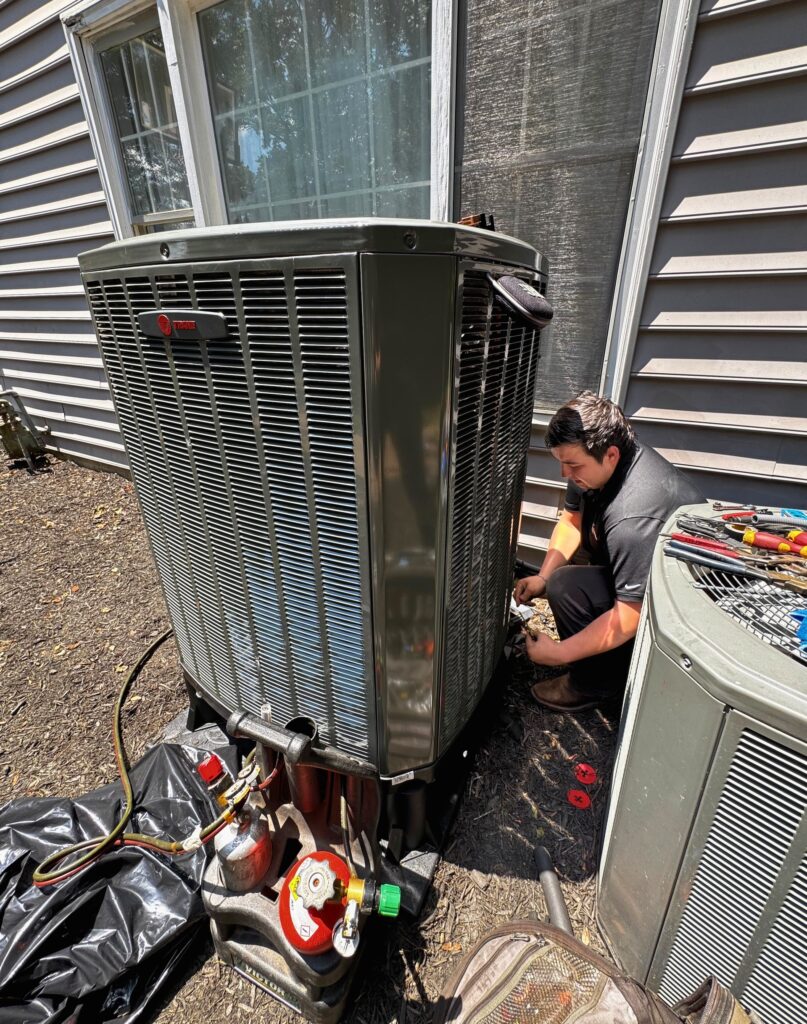
About half the owners inside the Town of Dumfries heat with electricity, and in a Dumfries house that usually means the unit out back is a heat pump. It cools in July and heats in January, so a repair on one should end with a test run in heat mode as well as cooling. The 1980s were the Town’s busiest building decade, about three homes in ten, which puts a lot of these on their third outdoor unit.
The townhouse rows set the pattern. Town records date Williamstown, the largest at about 455 homes, to 1974 through 1991, Port O’Dumfries to 1974 through 1988, and South Cove to 1988 through 1992. In those rows the air handler usually lives in a closet or the attic, and the condensers line up behind the units, where a privacy fence or a deck built too close can choke the air a condenser needs to shed its heat.
Past the town line it changes by neighborhood. Montclair, three houses in four single-family with a median built in 1989, leans electric just like the Town, so heat pumps again. Cherry Hill, the Census place covering most of 22026 outside the Town, is newer, its median owner home built in 2005, and about seven owners in ten burn gas. There it’s a furnace inside and a separate air conditioner out back sharing one blower, and the first ones are reaching the age when coils and compressors start to leak.
A repair needs nothing from anybody. A replacement does, and the office follows the town line. Inside it, the Town of Dumfries runs its own building department, and its mechanical permit application has a line for AC equipment replacement, indoor, outdoor or both. In the Town’s historic district, the Town Code holds building permits until a certificate of appropriateness is approved, which matters when a new condenser goes in a new spot. Outside the line, Prince William County handles it.