Utility gas heats just 46 of the 2,362 owner homes in 20141; electricity heats 1,257, mostly through heat pumps, and propane 953. So a Round Hill tune-up usually takes its gas readings on propane, at two points: what arrives at the furnace, and what the burners get past the gas valve.
At the Purcellville weather station, three miles east-northeast, January nights average 24.5 degrees, and a mesonet NWS listed read an unofficial minus 5 a mile southeast of Round Hill on January 23, 2025. On nights like those a heat pump leans on its backup: electric heat strips in most all-electric houses, a propane furnace where the two are paired. The tune-up runs the system until the backup comes on, since a part used a few nights a year is the likeliest to fail quietly.
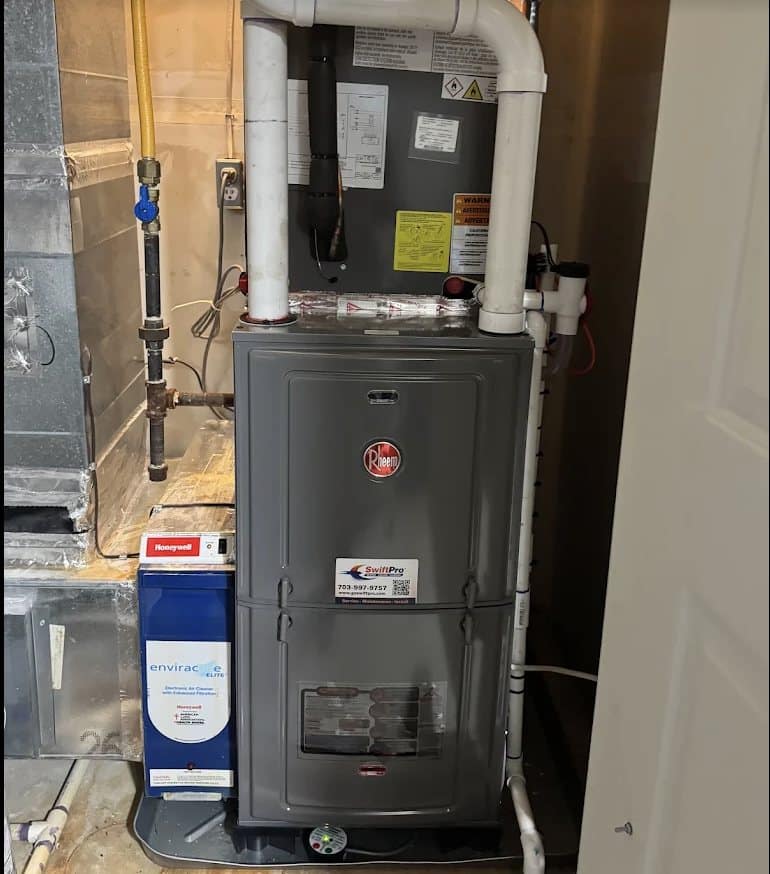
The Blizzard of 2016 left 36.3 inches a mile west-northwest of Round Hill, the second-highest total in the Weather Service’s final Loudoun count. A high-efficiency propane furnace usually breathes through two white plastic pipes in a side wall or the roof; bury them in a drift and it shuts itself off on its pressure switch, which is its job. The tune-up proves that switch still trips. A heat pump needs clearance too: set low on its pad, the water it sheds while defrosting can freeze into a block under the coil.
Freezing rain left up to 0.15 inch of ice at Round Hill on February 7, 2018, and in February 2010 the weight of the snow knocked out power across Loudoun County. A propane furnace stops with the power, since its igniter, inducer and blower run on electricity, and one that won’t relight once the lights are back is worth a call. In the old town, where the Town’s plan says most houses predate 1930, the furnace may vent into a masonry chimney far older than it; the tune-up checks the exhaust actually rises.