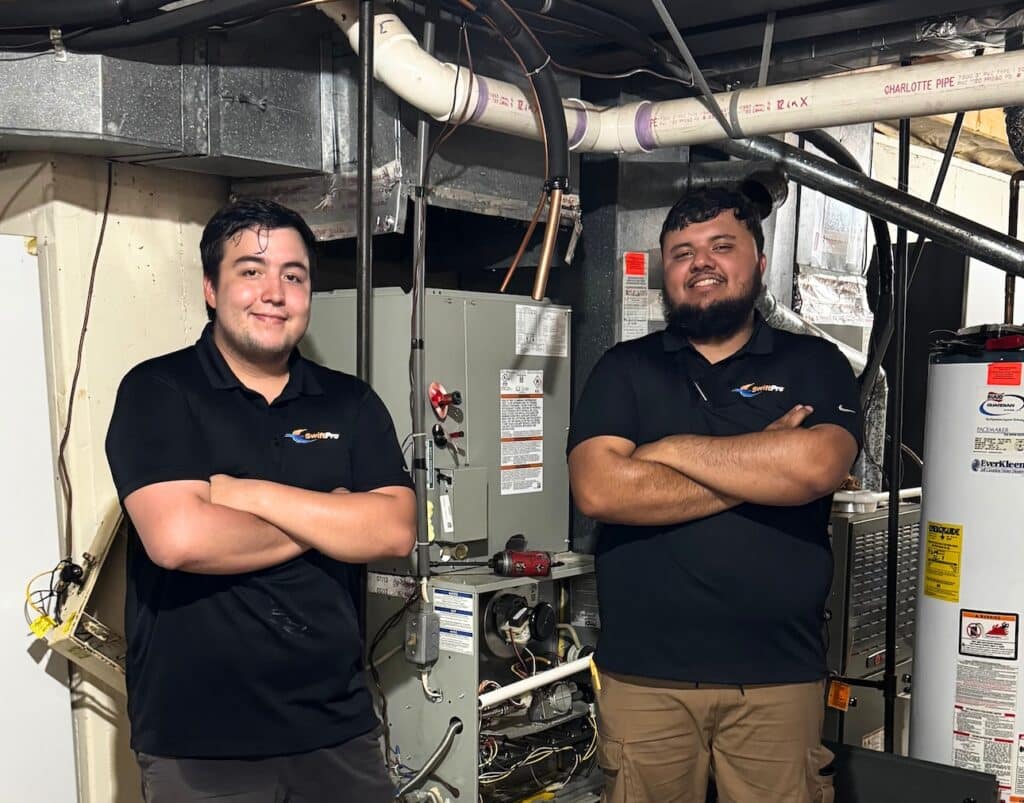
Natural gas heats about two thirds of the owner homes inside the town limits and about four in five out in Lansdowne. Propane is the small share, roughly one owner home in forty in town by the Census count, usually where no gas main runs. Either fuel gets the same visit, but not the same numbers: propane runs at a higher pressure than natural gas, and the tech holds yours to the figure for your fuel on the furnace’s rating plate.
Houses from the 1980s and 90s are the biggest slice of town, about 7,000 of them, and where one has moved to a high-efficiency furnace, that furnace makes water as it burns. Over a summer off, its drain trap can dry out or gum up, and a trap that can’t drain backs water up until the pressure switch stops the burners. The tune-up runs the furnace long enough to make water and watches it leave.
Downtown is the exception. The Census puts around 380 of the town’s homes before 1940, many in the Old and Historic District, where the Town’s design guidelines ask owners to keep their chimneys. Where a gas furnace still vents up an old masonry flue, the fall visit carries more weight: a chimney cold since spring can be slow to start drawing, and one safety a tune-up tests is the switch that stops the burners when exhaust spills back instead of rising. It’s why the county’s yearly advice, below, names chimneys too.
Close to four in ten Lansdowne homes are in condo and apartment buildings, where the furnace is often a compact unit in a hall closet. If that closet door has slats or a grille, it may be how the burners get their air, so keep coats off it and never swap in a solid door.