No water main reaches Casanova. Each house draws from its own well, drilled into the sandstone, siltstone and shale of the Turkey Run Formation, part of the old rift basin running through southeastern Fauquier, where USGS finds groundwater sitting higher than in the hard rock of the county’s northwest. The National Register survey of the village even lists old pump houses on two of its lots. The well, its pump and the pressure tank belong to a well contractor. From the tank on, the pipes, valves, fixtures and water heater are ours.
That high water table, and the creeks, make themselves known after hard rain. On December 7, 2011, a creek left its banks along Meetze Road after a gauge south of Warrenton caught 2.70 inches. High water covered a bridge on Rogues Road on May 16, 2014, and shut the road on November 12, 2020; on July 16, 2025, a foot of water ran across Balls Mill Road. Turkey Run’s USGS gauge at Meetze Road peaked at 1,010 cubic feet per second on May 5, 2019. If your basement takes water, the sump pump is the first defense, and one that runs without stopping and still loses ground needs replacing; our sump pump page has the one price. Call us after the storm and we’ll inspect the rest.
Then comes the cold. Half of all years at the Warrenton 3 SE station see a freeze after April 9 or before November 1, and on February 20, 2015, it bottomed out at 2 degrees after an afternoon that never passed 16. Fauquier’s code puts frost 24 inches down, so a line buried properly rides it out. What freezes in a Casanova house is what’s exposed: a supply line crossing a crawlspace under a stone foundation, a pipe in the outer wall of a bathroom added onto an old house, the line out to a barn. If one faucet runs dry on a bitter morning while the rest still flow, the pipe feeding it has likely frozen; close the main valve near the pressure tank before it thaws.
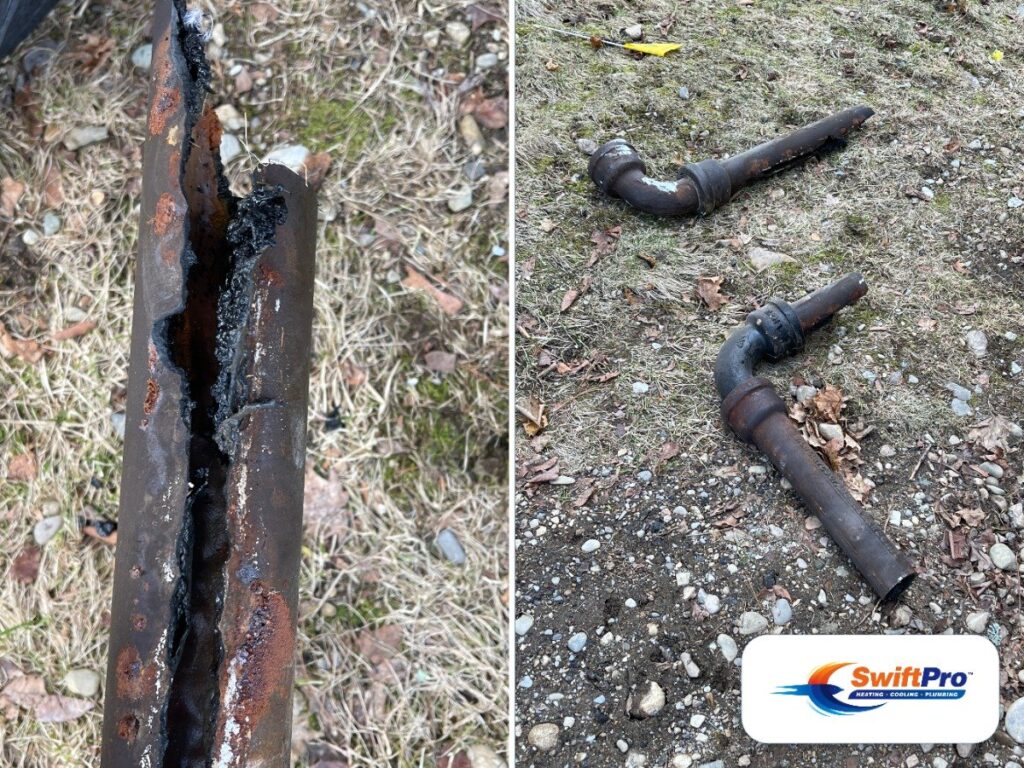
The age of the house sets the rest of the list. In ZIP 20119 about one owner home in six predates 1960, when galvanized steel was the usual supply pipe, and about a third went up between 1980 and 1999, the years polybutylene was in use. Polybutylene is the gray plastic line, often stamped PB, and in a house on a well it can run from the pressure tank to every fixture. It tends to let go at the fittings without warning. Leak detection, $200 to $500, finds a hidden leak before any wall comes open, and replacing the whole run is repiping, $1,000 to $12,000.