Water source is the first question. If you are a Loudoun Water customer, do not expect a hardness number from the utility: its 2025 report leaves hardness out, and its water quality page refers you to Fairfax Water’s figures. About a quarter of Loudoun residents, mostly in the west and north, depend on groundwater, and wells in different spots can yield very different amounts. On a private well, hardness and pressure belong to your own well, and only a test tells you where you stand.
Pressure is where the line gets drawn. Loudoun Water’s rules put the pressure regulator entirely on the customer, so on a Loudoun Water house a worn regulator is yours to replace. A fill valve hissing in the night, a toilet that keeps refilling or a relief valve weeping on the water heater are signs the pressure has crept up. Replacing the regulator is $500 to $1,000. On a well, pressure comes from your own pump and tank, which is a different check.
Winter is the other test. Mount Weather logs 104.7 days a year with a low at or below 32 degrees, Purcellville 114.7, and Mount Weather has 27.8 days when the high never climbs past freezing. Loudoun County’s design criteria list frost depth as 24 inches, which is how far down the freeze is planned to reach. Lines in outside walls, crawl spaces and hose bibs are what give way. When a pipe is leaking behind a wall and the source is hidden, locating the leak is $200 to $500.
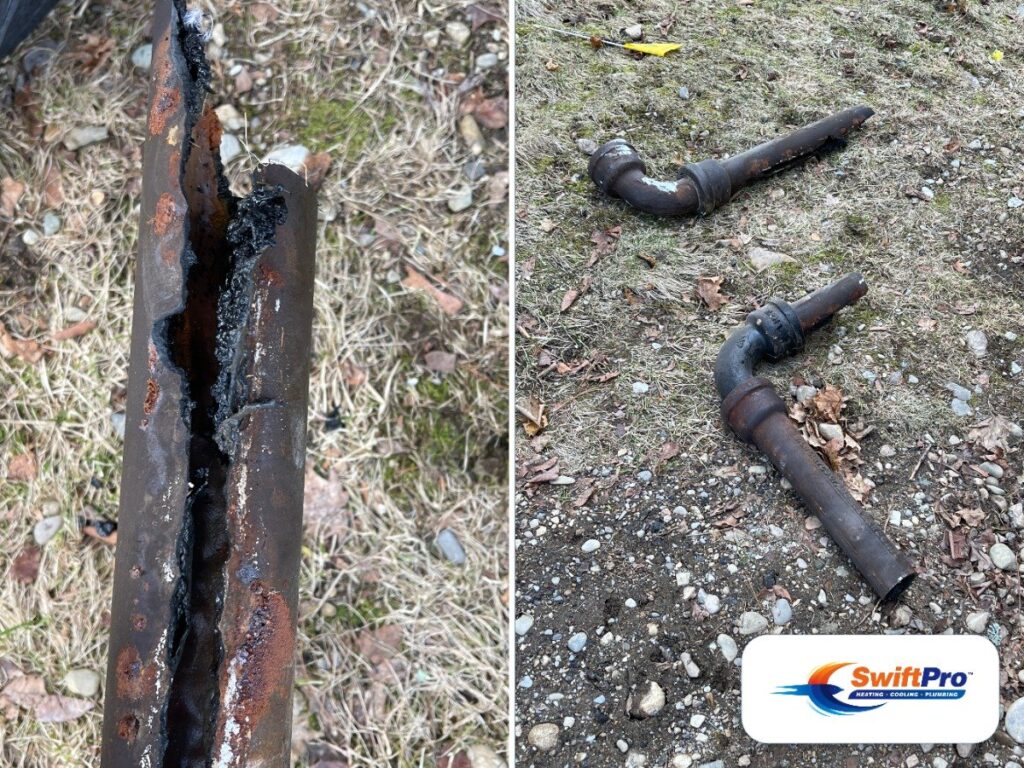
Age decides what is inside the walls. About one in three owner homes in ZIP 20135 went up before 1960 and nearly half before 1980, and houses from those years can still carry galvanized steel supply pipe or cast iron drains. More than nine in ten homes are detached, so a house usually has its own lines. Replacing the supply piping through a whole house is $1,000 to $12,000. If Loudoun Water is your sewer provider, the pipe beneath the street is its repair, while the pipe from the house to the street is yours.