Plenty of Fairfax Station basements started out unfinished. In a house from the 1980s the main ducts hang from the basement ceiling to feed the floors above, and when the lower level became a family room, an office or a guest suite, it usually got a couple of registers cut into those trunks and nothing more. It runs cold all winter and clammy in July, on a thermostat two floors up that only cares how the kitchen feels.
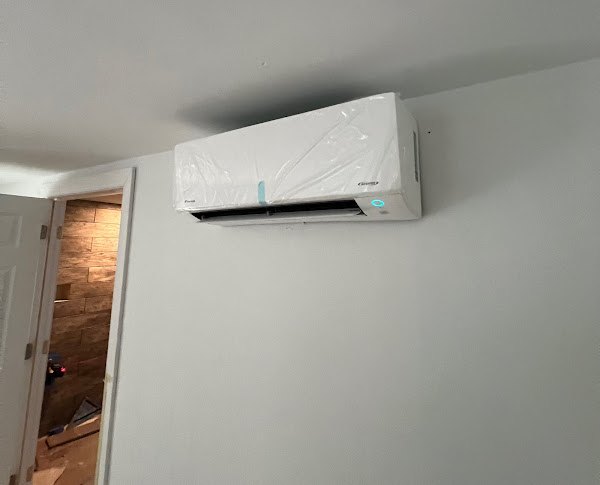
About 1 in 8 homes in 22039 is older than 1980, and about 150 predate 1960. A house that age has often been added onto, a den at the back, an enclosed porch, a bedroom over a later garage, each tied into ductwork drawn for the original rooms, and some of the oldest were never ducted for cooling at all. A head gives the room the ducts can’t reach its own heat and air, with no new duct runs through the walls.
On a five-acre lot the space that needs it may not be in the house at all. A workshop in a detached garage, a studio, an office over the barn: a single-zone system puts one head inside and one outdoor unit against the building, with nothing to run across the yard. If the building’s power feed is small, that gets checked before the price is final.
Most houses here already have central air in the main rooms, often two systems of it, so a ductless job tends to be a room or two, not the whole house. Where two rooms sit at opposite ends, ask for it priced both ways: one outdoor unit running two heads, or two single-zone systems with a short run each.